




Hahn’s Macaw for Sale

Original price was: $3,500.00.$2,500.00Current price is: $2,500.00.
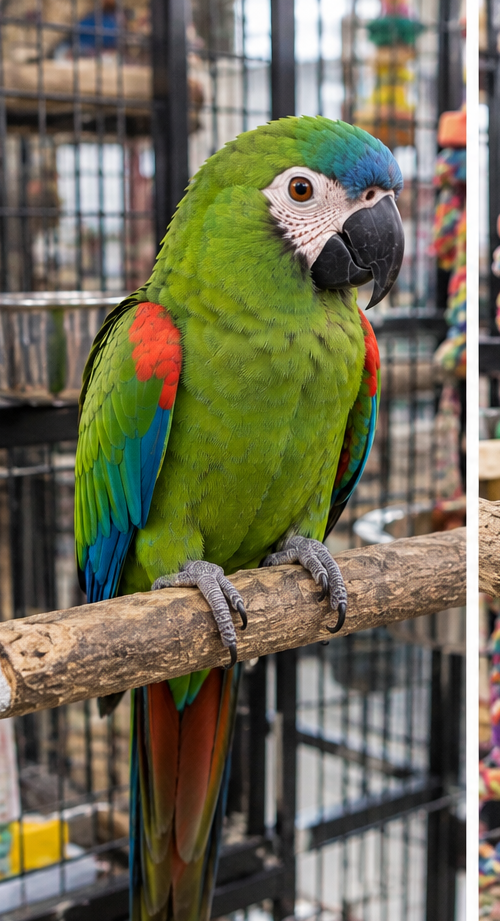
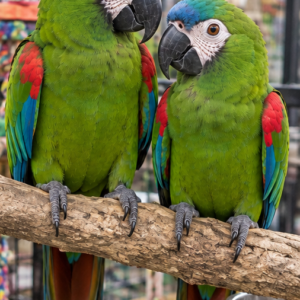
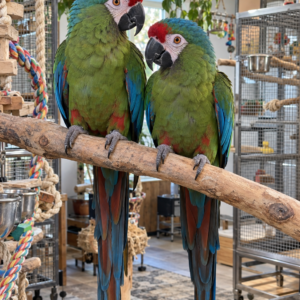
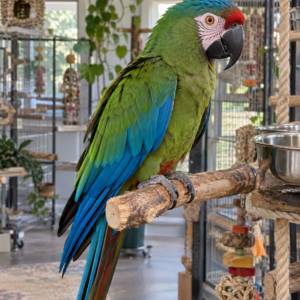
Male and female Hahn’s Macaws are represented in this listing. Hahn’s Macaw is the smallest macaw form and belongs to the Red-shouldered Macaw species, Diopsittaca nobilis. Adults are predominantly green with blue across the forehead, red colouring around the bend of the wing, a dark grey bill and pale facial skin. Adults reach approximately 11.7 inches, while the reported Hahn’s Macaw lifespan is around 25–40 years.
Hahn’s Macaw for Sale – Male & Female
For buyers researching a Hahn’s Macaw for sale, this compact parrot offers the characteristic appearance and active nature of a macaw in a much smaller body than species such as the Blue and Gold Macaw or Great Green Macaw.
Hahn’s Macaw is the nominate subspecies Diopsittaca nobilis nobilis within the Red-shouldered Macaw species.
The World Parrot Trust lists Diopsittaca nobilis at approximately 30 cm, or 11.7 inches, in length and 130–170 grams, or about 4.5–6 ounces, in weight. It specifically notes that the Red-shouldered Macaw is the smallest of all macaws.
Both male and female birds can have the same characteristic green, blue and red plumage, making documented sex information preferable when a buyer specifically wants one sex.
Hahn’s Macaw Details
- Common Name: Hahn’s Macaw
- Species: Red-shouldered Macaw
- Scientific Name: Diopsittaca nobilis
- Subspecies: Diopsittaca nobilis nobilis
- Sex Represented: Male and Female
- Bird Type: Macaw
- Adult Size: Approximately 11.7 inches
- Adult Weight: Approximately 130–170 g
- Reported Lifespan: Approximately 25–40 years
- Primary Colours: Green, blue and red
- CITES Listing: Appendix II
There are three recognized subspecies of Diopsittaca nobilis: D. n. nobilis, D. n. cumanensis and D. n. longipennis. Hahn’s Macaw specifically refers to the nominate D. n. nobilis.
What Does a Hahn’s Macaw Look Like?
The Hahn’s Macaw is predominantly yellow-green.
Adult birds show blue colouring across the forehead and forecrown, which contrasts with the otherwise green head and body.
The bend of the wing, carpal edge and some of the underwing feathers show red colouring.
The face is largely bare and pale, while the bill is dark grey.
Adult eyes are described as dark orange.
Juvenile birds look somewhat different. Younger Hahn’s Macaws generally have greener colouring across the forehead and crown, with less red around the wing bend than adults.
This means buyers should not assume that a young bird will display its full adult colour pattern immediately.
Male and Female Hahn’s Macaws
Both male and female Hahn’s Macaws are represented in this listing.
Males and females are visually very similar, so sex should not be determined only from appearance.
If a buyer specifically wants either a male or female bird, appropriate sex-identification documentation or veterinary testing is more reliable.
Sex should also not be treated as a guarantee of personality.
Individual temperament can be influenced by:
- Handling history
- Socialization
- Age
- Environment
- Daily routine
- Previous experiences
The individual bird should therefore be evaluated rather than relying only on whether it is male or female.
Hahn’s Macaw Size
The Hahn’s Macaw size is one of the biggest differences between this bird and most other macaws.
Adults reach approximately 11.7 inches, making them dramatically smaller than a Blue and Gold Macaw, Scarlet Macaw or Great Green Macaw.
The World Parrot Trust reports a weight range of only 130–170 grams.
This compact size is why Hahn’s Macaw is sometimes attractive to people who appreciate macaws but do not have the physical space required for one of the very large species.
However, smaller size does not mean minimal care.
Hahn’s Macaws remain active parrots that need room for climbing, movement, enrichment and supervised activity.
Hahn’s Macaw Lifespan
The reported Hahn’s Macaw lifespan is approximately 25–40 years.
That makes even this relatively small macaw a long-term commitment.
Actual lifespan varies according to factors including:
- Genetics
- Diet
- Veterinary care
- Exercise
- Housing
- Environmental safety
- Overall husbandry
Prospective owners should plan for decades of care rather than viewing a Hahn’s Macaw as a short-term pet.
Hahn’s Macaw Price
People researching Hahn’s Macaw price should consider more than a generic advertised number.
The price of an individual bird can vary depending on:
- Age
- Sex
- Handling history
- Health information
- Documentation
- Geographic location
- Current availability
- Individual training or socialization
Because no exact selling price has been supplied for this listing, the actual current product price should be displayed rather than inventing a market figure.
The initial Hahn’s Macaw price is also only one part of long-term ownership costs.
Buyers should consider housing, food, enrichment materials, routine veterinary care and potential unexpected veterinary expenses.
Hahn’s Macaw Sounds and Vocal Behaviour
Hahn’s Macaws are vocal parrots.
The World Parrot Trust describes their flight calls as shrill and repetitive, often produced in short bursts, with additional harsh notes. Groups of birds can create a vibrating overall tone when calling together.
Their smaller size should therefore not be mistaken for silence.
Prospective owners should expect normal parrot vocalization and consider whether their household environment can accommodate it.
Social Behaviour
Hahn’s Macaws are active parrots that benefit from regular interaction.
A stimulating daily routine can include:
- Training
- Climbing
- Exploring
- Chewing
- Foraging
- Supervised social interaction
The goal is to give the bird opportunities to use its intelligence and natural activity rather than spending most of the day without stimulation.
Individual birds differ in personality, so interaction should always respect the bird’s behaviour and comfort level.
Housing a Hahn’s Macaw
Despite the compact Hahn’s Macaw size, suitable housing should provide space for comfortable movement.
The World Parrot Trust recommends that birds kept in smaller enclosures receive access to a much larger flight area and notes that permanent indoor confinement is not ideal in avicultural settings.
A companion-bird setup should include:
- Appropriately sized perches
- Multiple perch positions
- Safe climbing opportunities
- Food and water stations
- Bird-safe chewing materials
- Foraging activities
- Toys
- Bathing opportunities
The surrounding room should also be checked carefully for hazards before supervised activity outside the enclosure.
Enrichment and Play
Hahn’s Macaws benefit from varied environmental enrichment.
The World Parrot Trust recommends:
- Play gyms
- Roomy housing
- Multiple perches
- Swings
- Ladders
- Foraging toys
- Puzzle toys
Enrichment should not remain exactly the same indefinitely.
Rotating suitable toys and activities can provide different challenges while encouraging movement and exploration.
Hahn’s Macaw Diet
A balanced diet is essential for long-term health.
The World Parrot Trust’s husbandry information references a varied feeding program that can include suitable nuts, fresh corn, fruits and complete formulated macaw food.
However, an individual bird’s diet should be based on its health, age, activity and professional veterinary recommendations.
A generic food list should not replace individualized guidance.
The Association of Avian Veterinarians provides dedicated educational information for macaw owners through its Pet Bird Care Series.
Association of Avian Veterinarians – Macaw Care
Veterinary Care
An avian veterinarian should be identified before bringing a Hahn’s Macaw home.
Routine examinations can help establish baseline information concerning:
- Weight
- Body condition
- Beak and feet
- Plumage
- Nutrition
- Respiratory health
- General wellbeing
The Association of Avian Veterinarians maintains professional resources for bird owners and a directory for locating veterinarians with avian experience.
Association of Avian Veterinarians
Natural Range of Hahn’s Macaw
The nominate Hahn’s Macaw, Diopsittaca nobilis nobilis, occurs naturally north of the Amazon River.
Its range includes portions of eastern Venezuela, the Guianas and northeastern Brazil.
Other subspecies occur farther south and east in Brazil.
Natural range information describes wild populations and should not be interpreted as proof of the origin of an individual captive bird.
Conservation and Responsible Ownership
The World Parrot Trust currently reports the global Red-shouldered Macaw population trend as stable and lists the species under CITES Appendix II.
Some illegal trade involving wild birds has occurred historically, particularly in parts of Bolivia.
For this reason, responsible buyers should review applicable captive-origin, identification and transfer documentation.
The World Parrot Trust also emphasizes that parrots require significant physical, social and medical care and that successful parrot ownership depends on providing appropriate space, knowledge and stimulation.
Hahn’s Macaw vs Large Macaws
A Hahn’s Macaw is dramatically smaller than large species such as the Blue and Gold Macaw.
For comparison, Blue and Gold Macaws can reach about 33.5 inches and have a reported longevity of around 60 years, while Hahn’s Macaws measure about 11.7 inches with a reported 25–40 year lifespan.
The smaller size means equipment and physical space requirements differ, but both remain intelligent parrots requiring enrichment and long-term care.
Preparing for Hahn’s Macaw Ownership
Anyone considering a Hahn’s Macaw for sale should prepare the bird’s environment before bringing it home.
This includes:
- Suitable housing
- Safe perches
- Feeding and water equipment
- Climbing opportunities
- Foraging enrichment
- Chewable toys
- Access to avian veterinary care
Prospective owners should also consider noise, lifespan and daily interaction requirements.
The compact body of a Hahn’s Macaw does not remove the behavioural and environmental needs associated with keeping an intelligent parrot.
Why Hahn’s Macaw Is Distinctive
The Hahn’s Macaw combines many classic macaw characteristics with an exceptionally compact body.
Its green plumage, blue forehead, red wing markings, curved bill and long tail create the familiar macaw profile in a bird measuring only around 11.7 inches.
For buyers searching for a Hahn’s Macaw for sale, the bird’s size may be appealing, but long-term housing, enrichment, veterinary care and potential 25–40 year lifespan should all be considered alongside the purchase price.
Frequently Asked Questions
What is a Hahn’s Macaw?
Hahn’s Macaw is the nominate subspecies Diopsittaca nobilis nobilis of the Red-shouldered Macaw.
What is the Hahn’s Macaw size?
Adults reach approximately 30 cm, or 11.7 inches, in length.
How much does a Hahn’s Macaw weigh?
The species ranges from approximately 130–170 grams, or 4.5–6 ounces.
What is the Hahn’s Macaw lifespan?
The reported Hahn’s Macaw lifespan is approximately 25–40 years.
What does a Hahn’s Macaw look like?
Adults are predominantly green with blue across the forehead and crown, red around the bend of the wing, a pale facial area and dark grey bill.
What is the Hahn’s Macaw price?
The price varies according to age, sex, documentation, handling history, location and availability. The current product listing should display the actual selling price.
Are male and female Hahn’s Macaws different in appearance?
Male and female birds look very similar externally. Confirmed sex should rely on appropriate documentation or testing rather than appearance alone.
Is Hahn’s Macaw the smallest macaw?
The World Parrot Trust identifies the Red-shouldered Macaw as the smallest of all macaws, with individuals around 165 g highlighted in its species profile.
Do Hahn’s Macaws need enrichment?
Yes. Play gyms, multiple perches, swings, ladders and foraging or puzzle toys are among the enrichment options recommended for the species.
Where can I learn more about Hahn’s Macaw care?
The Association of Avian Veterinarians provides a dedicated macaw resource through its Pet Bird Care Series:
Be the first to review “Hahn’s Macaw for Sale”
Related products
Macaw Parrots


Macaw Parrots

Macaw Parrots


Macaw Parrots

Macaw Parrots
Macaw Parrots


Macaw Parrots
Macaw Parrots
Reviews
There are no reviews yet.