


Catalina Macaw for Sale

$2,300.00
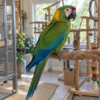
The Catalina Macaw is a first-generation hybrid between a Blue-and-Gold Macaw and a Scarlet Macaw. Often called a rainbow macaw, this large parrot can combine blue, yellow, orange, red and green plumage in highly variable patterns. Buyers researching a Catalina Macaw for sale should consider the bird’s individual temperament, size, handling history, health information, housing needs and long-term veterinary care.
Catalina Macaw for Sale – Hybrid Macaw
For buyers searching for a Catalina Macaw for sale, the most important fact to understand is that the Catalina is a hybrid macaw, not a naturally recognized macaw species with its own separate scientific name.
A Catalina Macaw is produced by crossing a Blue-and-Gold Macaw (Ara ararauna) with a Scarlet Macaw (Ara macao). The hybrid can therefore be represented scientifically as Ara ararauna × Ara macao.
Because Catalina Macaws inherit characteristics from two different parent species, their exact colouring, body proportions and behavioural traits can vary considerably between individuals.
That variation is one of the reasons buyers should evaluate the actual bird rather than assuming every Catalina will look or behave exactly the same.
Catalina Macaw Details
- Common Name: Catalina Macaw
- Alternative Name: Rainbow Macaw
- Bird Type: Hybrid Macaw
- Parent Species: Blue-and-Gold Macaw × Scarlet Macaw
- Hybrid Notation: Ara ararauna × Ara macao
- General Size: Large macaw
- Colour Range: Blue, yellow, orange, red and green
- Interaction: Intelligent, active and social
- Vocal Behaviour: Vocal communicator
- Care Level: Substantial space, enrichment and long-term avian care required
Catalina Macaws do not have a single naturally evolved wild population because they are primarily produced through hybrid breeding.
What Does a Catalina Macaw Look Like?
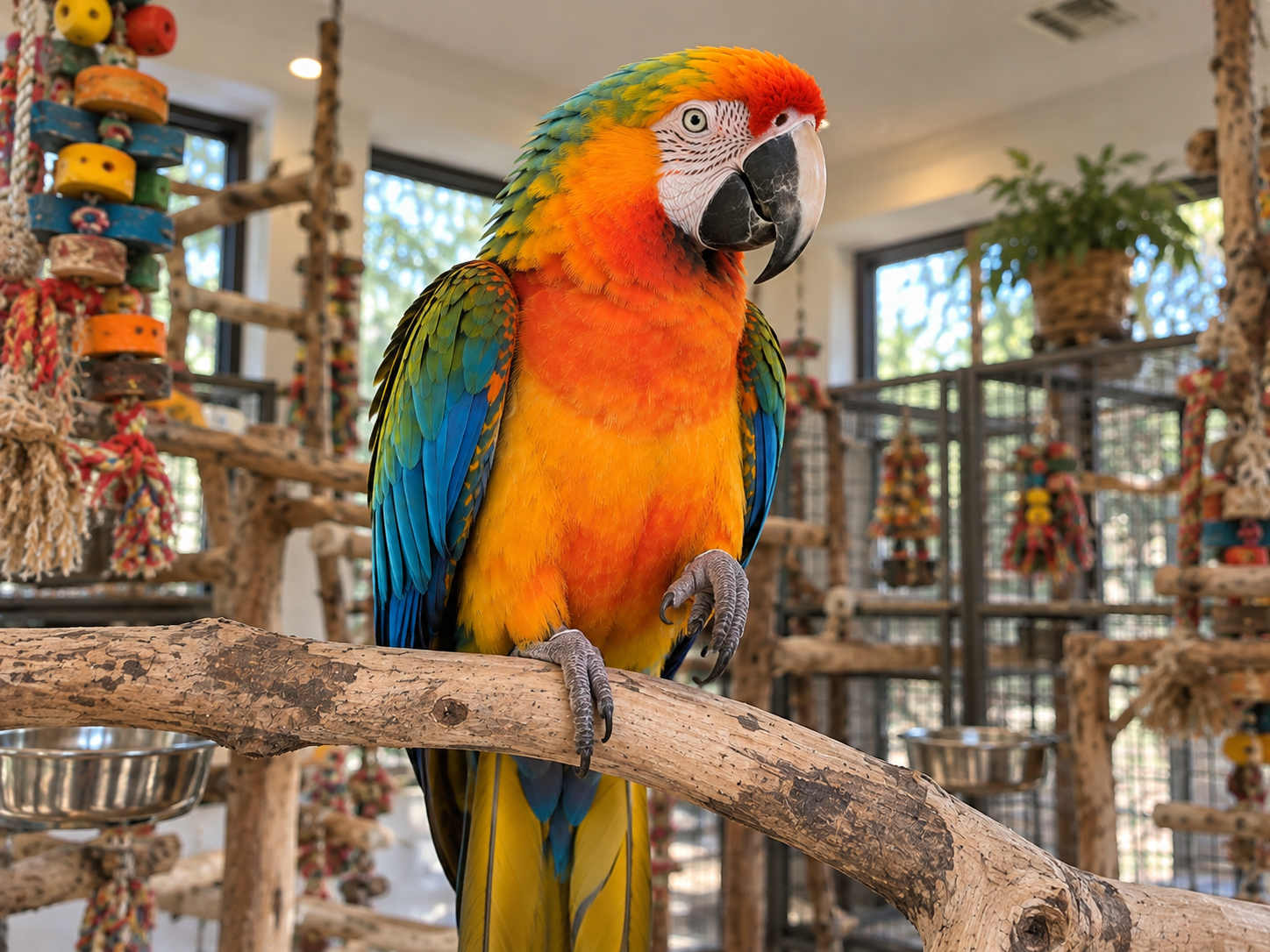
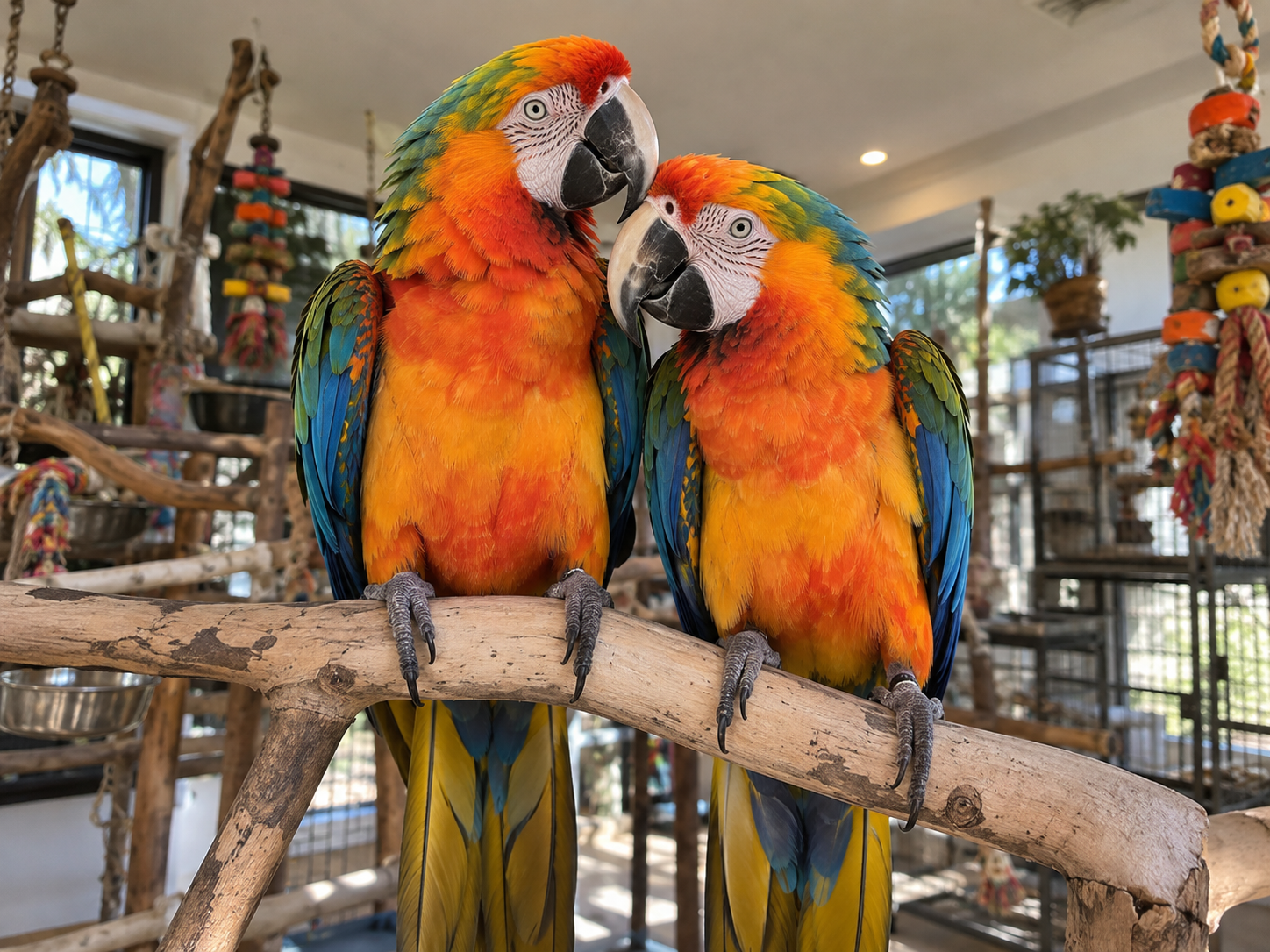
One of the most distinctive qualities of the Catalina Macaw is the wide variation in plumage.
The Blue-and-Gold parent contributes strong blue and yellow colouring, while the Scarlet Macaw contributes vivid red, yellow and additional blue tones.
Many Catalina Macaws therefore show:
- Blue wings and back
- Orange or golden chest plumage
- Red or reddish-orange head markings
- Green around portions of the crown
- Long multicoloured tail feathers
- Pale facial skin with fine feather lines
- A large curved macaw bill
Some individuals may lean visually closer to the Blue-and-Gold parent, while others may show stronger Scarlet Macaw influence.
For SEO product photography, images of the actual bird are particularly valuable because Catalina colouring can vary considerably.
Catalina Macaw Size
Catalina Macaws are large parrots because both parent species are large macaws.
Blue-and-Gold Macaws average about 34 inches, while Scarlet Macaws also average about 34 inches according to LafeberVet’s macaw identification guide.
As a result, adult Catalina Macaws generally require the same kind of substantial space associated with large macaws.
A prospective owner should prepare housing that gives the bird enough room for:
- Comfortable movement
- Wing stretching
- Climbing
- Strong perches
- Large enrichment items
- Supervised activity outside the main enclosure
Their large physical size also means household space should be considered before purchase.
Catalina Macaw Personality
Catalina Macaws combine genetic influence from both Blue-and-Gold and Scarlet Macaws, but personality cannot be predicted perfectly from parentage alone.
Large macaws are generally intelligent, social and capable of forming strong relationships with familiar people.
The Association of Avian Veterinarians describes Blue-and-Gold Macaws as intelligent birds with boisterous personalities that require significant space and constant stimulation in captivity.
Scarlet Macaws are also intelligent, energetic and highly active parrots.
A Catalina may therefore be playful, curious, vocal and socially engaged, but individual behaviour should always be evaluated bird by bird.
Catalina Macaw Price
People searching for Catalina Macaw price are usually comparing several factors before purchasing.
There is no single universal Catalina Macaw price because the cost of an individual bird can vary according to:
- Age
- Sex
- Handling history
- Health information
- Documentation
- Individual temperament
- Geographic location
- Breeder or seller
- Current availability
Because you have not provided an exact selling price for this product, the page should display your actual current price rather than using an invented market figure.
The purchase price is also only one part of the cost of ownership.
Long-term expenses may include:
- Large-bird housing
- Strong perches
- High-quality food
- Enrichment and replacement toys
- Routine avian veterinary examinations
- Unexpected medical care
A responsible buyer should therefore consider ongoing ownership costs alongside the initial Catalina Macaw price.
Male and Female Catalina Macaws
Male and female large macaws can be difficult to distinguish visually.
LafeberVet notes that macaws are generally sexually monomorphic, meaning males and females can look very similar externally.
For buyers who specifically want a male or female Catalina Macaw, documented sex identification or appropriate testing is preferable to visual guessing.
Sex should also not be used as the sole predictor of personality.
Individual experience, handling and socialization can influence behaviour significantly.
Housing a Catalina Macaw
A Catalina Macaw requires substantial space.
This is not a small parrot that can comfortably remain in a compact enclosure throughout the day.
The primary housing should accommodate:
- The bird’s long tail
- Full-body movement
- Multiple strong perches
- Large feeding stations
- Climbing opportunities
- Large-bird enrichment
Macaws also have powerful bills, so cages, perches and enrichment items need to be appropriately durable.
Regular supervised activity outside the main enclosure can also provide additional opportunities for movement and interaction where the environment is safe.
Enrichment and Mental Stimulation
Large macaws require ongoing stimulation.
The AAV notes that Blue-and-Gold Macaws need constant stimulation in captivity to remain healthy.
A Catalina Macaw may benefit from:
- Large bird-safe chew toys
- Foraging activities
- Strong natural branches
- Climbing structures
- Training sessions
- Puzzle-style enrichment
- Bathing opportunities
- Social interaction
Enrichment should be rotated periodically rather than leaving exactly the same objects in the enclosure indefinitely.
Diet and Nutrition
Macaw nutrition should be varied and appropriate to the individual bird.
LafeberVet describes wild Blue-and-Gold Macaw diets as including seeds, fruits and nuts, while Scarlet Macaws naturally consume fruits, nuts and additional plant material.
However, a captive Catalina Macaw should not simply be fed a copy of a wild diet.
The Association of Avian Veterinarians emphasizes the importance of a high-quality and varied diet for captive macaws.
Owners should establish an appropriate feeding program with an avian veterinarian.
For professional companion-bird information:
Association of Avian Veterinarians – Pet Bird Care
Catalina Macaw vs Harlequin Macaw
The keyword “harlequin catalina macaw” can create confusion because Catalina and Harlequin Macaws are two different hybrids.
A Catalina Macaw is:
Blue-and-Gold Macaw × Scarlet Macaw
A Harlequin Macaw is:
Blue-and-Gold Macaw × Green-winged Macaw
The Green-winged Macaw is a separate large macaw species with darker red plumage and green across the centre of the wings.
Therefore, “Harlequin Catalina Macaw” should not be presented as though it were simply another standard name for a Catalina.
There are later-generation macaw hybrids involving both Catalina and Harlequin parentage, but those should be identified separately rather than confusing them with a standard first-generation Catalina.
Catalina Macaw vs Blue and Gold Macaw
The Blue-and-Gold Macaw is one of the Catalina’s parent species.
A standard Blue-and-Gold has a relatively predictable colour pattern dominated by blue upper plumage and yellow underparts.
A Catalina Macaw can inherit additional red and orange colouring from its Scarlet Macaw parent, creating a much more variable appearance.
Both are large macaws requiring significant physical space and enrichment.
Catalina Macaw vs Scarlet Macaw
The Scarlet Macaw is the second parent species of the Catalina.
Scarlet Macaws are dominated by vivid red plumage with yellow and blue through the wings. They are large, intelligent and energetic parrots.
Catalina Macaws may inherit the Scarlet’s red and orange colouring but usually show significant blue-and-yellow influence from the Blue-and-Gold parent as well.
Veterinary Care
Anyone purchasing a Catalina Macaw should establish access to an avian veterinarian.
Routine examinations can provide baseline information concerning:
- Body weight
- Beak and feather condition
- Diet
- Activity level
- Respiratory health
- General body condition
Professional veterinary advice is particularly important for a large parrot that may remain in a household for decades.
The Association of Avian Veterinarians provides bird-owner care resources:
Association of Avian Veterinarians
Preparing for Catalina Macaw Ownership
Before choosing a Catalina Macaw for sale, buyers should consider more than colour or appearance.
A suitable home needs:
- Adequate physical space
- Durable housing
- Strong perches
- Daily enrichment
- Regular interaction
- Appropriate nutrition
- Avian veterinary access
- Long-term financial planning
Macaws are also naturally vocal, so household noise tolerance should be considered.
A well-planned environment is especially important for an intelligent and active hybrid like the Catalina.
Why the Catalina Macaw Is Distinctive
The Catalina Macaw combines traits from two of the world’s best-known large macaws.
Its Blue-and-Gold and Scarlet parentage can produce vivid mixtures of blue, orange, red, gold, yellow and green plumage.
Unlike a true macaw species, the Catalina is a hybrid, so individual appearance and behaviour can vary more widely.
For anyone searching for a Catalina Macaw for sale, the best approach is to evaluate the actual bird, verify available documentation and prepare for the long-term responsibilities associated with keeping a large macaw.
Frequently Asked Questions
What is a Catalina Macaw?
A Catalina Macaw is a first-generation hybrid between a Blue-and-Gold Macaw and a Scarlet Macaw.
Does the Catalina Macaw have a scientific name?
Because it is a hybrid rather than a separate species, it does not have its own conventional species name. It can be represented as Ara ararauna × Ara macao.
What colours does a Catalina Macaw have?
Colour varies by individual, but Catalina Macaws can display blue, yellow, orange, red and green plumage.
How big is a Catalina Macaw?
Catalina Macaws are large parrots. Both parent species average around 34 inches in length, although individual hybrids can vary.
What is the Catalina Macaw price?
The Catalina Macaw price varies according to age, sex, location, handling history, documentation and availability. The actual product listing should show the current price rather than relying on a generic estimate.
Is a Catalina Macaw the same as a Harlequin Macaw?
No. A Catalina is a Blue-and-Gold × Scarlet hybrid. A Harlequin is a Blue-and-Gold × Green-winged hybrid.
What does “Harlequin Catalina Macaw” mean?
The phrase may be used in searches relating to hybrid macaws, but Catalina and Harlequin are separate first-generation hybrids. Later-generation crosses involving those hybrids should be identified specifically.
Are Catalina Macaws social?
Large macaws are generally highly social and intelligent birds. Individual Catalina personality varies according to parentage, socialization, handling and environment.
Where can I learn more about macaw care?
The Association of Avian Veterinarians provides professional companion-bird resources:
Be the first to review “Catalina Macaw for Sale”
Related products
Macaw Parrots
Macaw Parrots

Macaw Parrots

Macaw Parrots

Macaw Parrots

Macaw Parrots


Macaw Parrots


Macaw Parrots
Reviews
There are no reviews yet.