
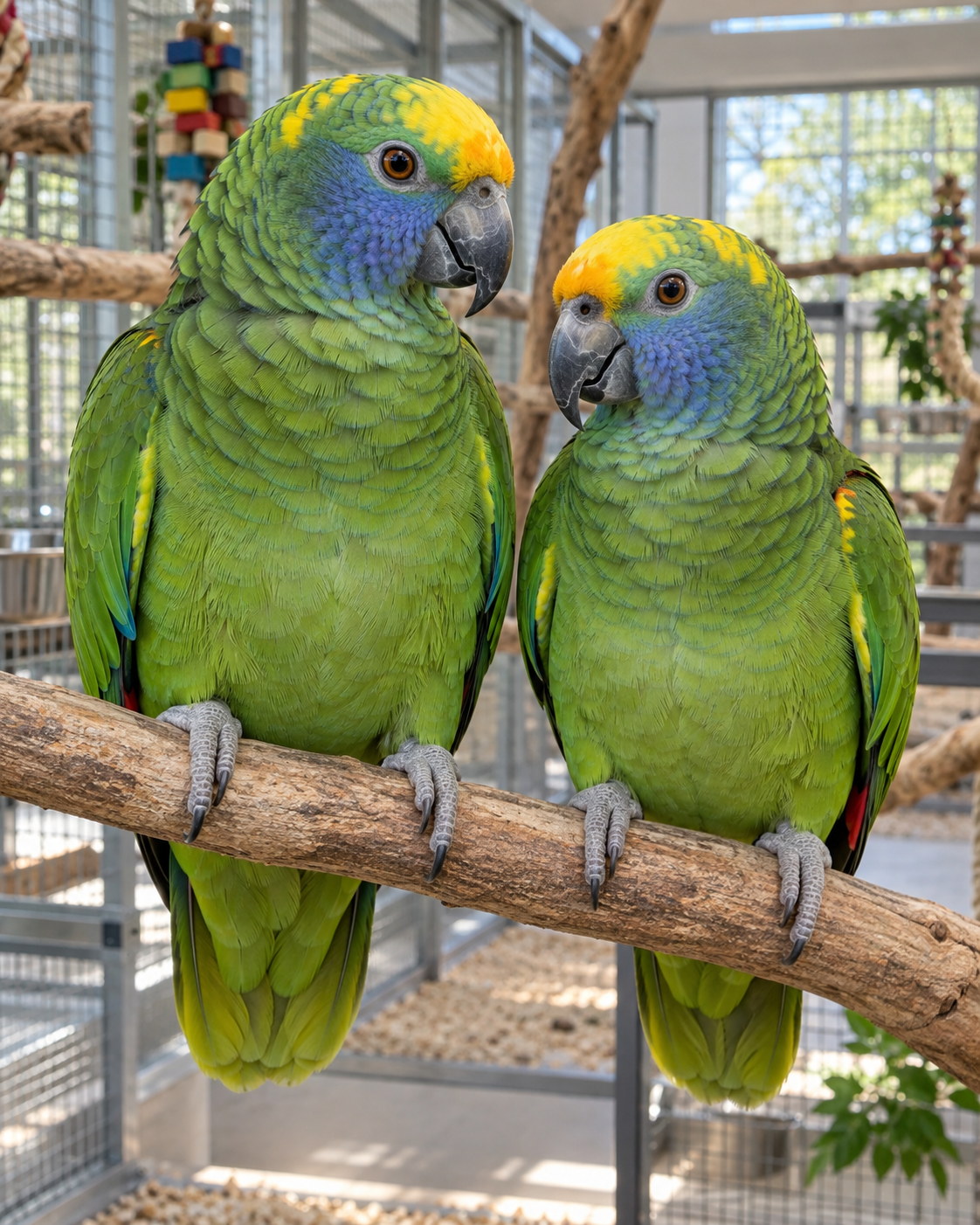
Blue-Cheeked Amazon


$730.00
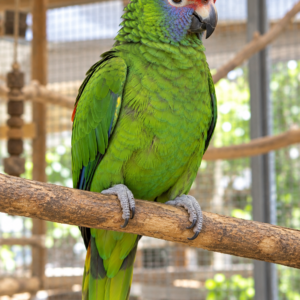
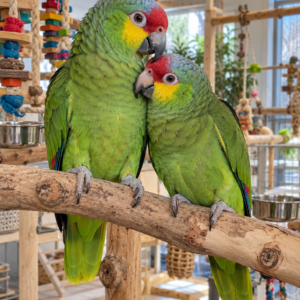
The Blue-Cheeked Amazon is a distinctive Amazon parrot scientifically known as Amazona dufresniana. Male and female birds are represented in this listing. Adults are predominantly green with striking blue and violet-blue cheek colouring, yellow and orange tones around the forehead, and an adult size of approximately 13.3 inches.
Blue-Cheeked Amazon – Male & Female Parrots
The Blue-Cheeked Amazon is a visually distinctive member of the Amazon parrot group, particularly recognized for the blue colouring around its cheeks and face. Scientifically known as Amazona dufresniana, this species combines predominantly green body plumage with contrasting yellow, orange and blue facial markings.
This listing represents male and female Blue-Cheeked Amazon parrots for buyers specifically researching this species rather than a general Amazon parrot.
For prospective owners comparing different Amazon species, using the correct common and scientific names is useful because many Amazon parrots share green body plumage but differ considerably in facial markings, size, natural range and conservation status.
Blue-Cheeked Amazon Details
- Common Name: Blue-Cheeked Amazon
- Alternative Name: Blue-Cheeked Parrot
- Other Name: Dufresne’s Amazon
- Scientific Name: Amazona dufresniana
- Sex Represented: Male and Female
- Bird Type: Amazon Parrot
- Adult Length: Approximately 34 cm / 13.3 inches
- Reported Adult Weight: Approximately 480–600 g
The World Parrot Trust currently identifies the Blue-Cheeked Amazon as Amazona dufresniana and lists an adult size of about 34 cm, or 13.3 inches, with weights around 480–600 g.
What Does a Blue-Cheeked Amazon Look Like?
The species gets its common name from one of its most recognizable physical characteristics: blue colouring across the cheeks.
Adults are predominantly green. However, the head carries several contrasting colours that distinguish the species from many related Amazon parrots.
According to the World Parrot Trust, adult Blue-Cheeked Amazons can show orange-yellow colouring across the forehead and lores, yellow around portions of the crown, bright blue from the front cheek area beneath the eye, and violet-blue coloring farther across the lower cheek and ear-coverts.
The neck and upper back feathers can also carry darker scalloped edging.
These color combinations create a considerably more detailed appearance than the simple description “green Amazon parrot” would suggest.
Male and Female Blue-Cheeked Amazons
Both male and female Blue-Cheeked Amazon parrots are represented in this listing.
Prospective owners should avoid assuming that personality can be predicted solely by whether a parrot is male or female. Individual behavior, previous handling, socialization, environment and experience can all influence how a particular bird interacts with people.
Where the sex of an individual bird matters to the buyer, reliable documentation should be used instead of attempting to determine sex based only on appearance.
The World Parrot Trust describes the adult plumage of both sexes together rather than identifying a pronounced visual difference between males and females.
Natural Range of Amazona Dufresniana
The natural distribution of the Blue-Cheeked Amazon is in northern South America.
The species occurs from extreme eastern Venezuela through Guyana and Suriname into French Guiana. Records have also been reported from parts of northern Brazil.
Its natural environments include rainforest, cloud forest and some savanna woodland habitats.
Wild birds are generally associated with forest canopy and may be found in pairs or small groups, with larger gatherings occurring around communal roosting sites.
These facts describe the species in the wild and should not be used to infer the origin or history of an individual captive bird.
Blue-Cheeked Amazon Diet and Nutrition
Appropriate nutrition is one of the central responsibilities of keeping any companion parrot.
The World Parrot Trust’s husbandry information for the Blue-Cheeked Amazon references a varied diet incorporating fruits, vegetables, leafy greens, pulses and a complete pellet component.
However, a companion bird’s diet should be tailored to the individual rather than copied directly from a general species profile.
Age, health, activity, body condition and veterinary recommendations can all affect nutritional requirements.
For professional companion-bird care information, prospective owners can also consult the Association of Avian Veterinarians:
Association of Avian Veterinarians – Pet Bird Care
Housing a Blue-Cheeked Amazon
A Blue-Cheeked Amazon requires housing that allows comfortable movement and provides opportunities for activity rather than functioning simply as a place to keep the bird confined.
The World Parrot Trust recommends substantial aviary dimensions for the species in avicultural settings, reflecting the need for adequate room to move.
For a companion bird, the actual environment should be selected according to the bird’s individual needs and should incorporate appropriate perches, feeding areas and enrichment opportunities.
Housing should also be positioned in a safe environment away from avoidable household hazards.
Enrichment and Daily Activity
Parrots are intelligent animals that benefit from opportunities to interact with their environment.
Suitable enrichment can involve climbing, chewing, manipulating bird-safe objects and searching for food.
Rather than relying on the same toys indefinitely, enrichment can be changed periodically to provide different forms of stimulation.
The Association of Avian Veterinarians provides educational material for bird owners that covers husbandry, behaviour, nutrition, enrichment and other aspects of companion-bird care:
Daily care should also include appropriate social interaction and observation of the individual bird’s normal behaviour.
Veterinary Care for a Blue-Cheeked Amazon
Prospective owners should identify an avian veterinarian before bringing home an Amazon parrot.
Routine veterinary examinations can help establish baseline information concerning weight, general health, nutrition and individual care needs.
An owner should not wait until an obvious medical problem appears before determining where qualified avian veterinary care is available.
The Association of Avian Veterinarians provides a directory designed to help bird owners locate veterinarians:
AAV Find an Avian Veterinarian
Conservation Status of the Blue-Cheeked Amazon
Responsible ownership also means understanding the conservation background of the species.
The World Parrot Trust currently lists the Blue-Cheeked Amazon as Near Threatened and reports a decreasing wild population estimated at roughly 6,000–61,000 mature individuals. It is also listed under CITES Appendix II.
Habitat loss is identified as a significant concern, with trade also presenting a threat to wild populations.
Wild conservation status and the legal status of an individual captive bird are separate issues. Buyers should therefore review whatever origin, identification or transfer documentation is applicable to the individual bird and their jurisdiction.
Preparing for Blue-Cheeked Amazon Ownership
Anyone considering a Blue-Cheeked Amazon should think beyond the initial purchase.
Before bringing a bird home, the prospective owner should have suitable housing prepared, a plan for daily interaction and enrichment, appropriate feeding arrangements and access to qualified veterinary care.
Household schedules should also be considered. A parrot requires ongoing attention and regular maintenance of its environment.
Choosing a companion bird should therefore be based on whether the household can support the bird’s long-term needs rather than appearance alone.
Why the Blue-Cheeked Amazon Is Distinctive
Among Amazon parrots, Amazona dufresniana has a particularly recognizable combination of colours.
The orange-yellow forehead, blue to violet-blue cheek areas and predominantly green body distinguish the Blue-Cheeked Amazon from other members of the genus.
Its relatively uncommon captive status also makes accurate species identification especially important. The World Parrot Trust currently describes the species as very rare in captivity.
For buyers specifically researching this species, understanding its identification, care requirements, natural history and conservation background provides a stronger foundation for responsible ownership.
Frequently Asked Questions
What is a Blue-Cheeked Amazon?
The Blue-Cheeked Amazon is an Amazon parrot scientifically known as Amazona dufresniana. It is also called Dufresne’s Amazon or the Blue-Cheeked Parrot.
How large is a Blue-Cheeked Amazon?
Adults are approximately 34 cm, or 13.3 inches, long according to the World Parrot Trust.
What colours does a Blue-Cheeked Amazon have?
Adults are predominantly green with orange-yellow forehead colouring, yellow on parts of the crown and distinctive blue to violet-blue cheeks.
Are male and female Blue-Cheeked Amazon parrots represented?
Yes. This listing represents both male and female Blue-Cheeked Amazons.
Where does the Blue-Cheeked Amazon come from naturally?
Its natural range includes eastern Venezuela, Guyana, Suriname and French Guiana, with additional records from northern Brazil.
Is the Blue-Cheeked Amazon endangered?
The World Parrot Trust currently reports the species as Near Threatened, with a decreasing wild population.
Where can I learn about responsible Amazon parrot care?
The Association of Avian Veterinarians provides educational information for companion-bird owners:
How can I locate an avian veterinarian?
You can use the Association of Avian Veterinarians’ veterinarian directory:
AAV Find an Avian Veterinarian
Be the first to review “Blue-Cheeked Amazon”
Related products
Amazon Parrots
Amazon Parrots
Amazon Parrots
Amazon Parrots

Amazon Parrots

Amazon Parrots

Amazon Parrots


Amazon Parrots
Reviews
There are no reviews yet.