




Moluccan Cockatoo for Sale

Original price was: $2,500.00.$2,000.00Current price is: $2,000.00.
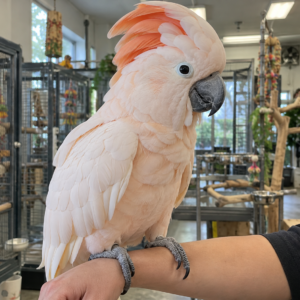
Male and female Moluccan Cockatoos are represented in this listing. Scientifically known as Cacatua moluccensis, this large Indonesian cockatoo is recognized for its soft peach-white plumage and dramatic dark salmon-pink crest. Adults reach approximately 15.6–19.5 inches and generally weigh around 775–935 grams. With a reported Moluccan Cockatoo lifespan of approximately 40–60 years, these highly social parrots require substantial housing, regular enrichment, strong chewing materials, appropriate nutrition and long-term avian veterinary care.
Moluccan Cockatoo for Sale – Male & Female
For buyers researching a moluccan cockatoo for sale, the Moluccan Cockatoo is one of the largest and most visually distinctive white cockatoos, known for its soft salmon colouring and dramatic crest.
Scientifically classified as Cacatua moluccensis, the species is also known as the Salmon-crested Cockatoo, Pink-crested Cockatoo and Rose-crested Cockatoo.
Adults reach approximately 15.6–19.5 inches in length and weigh around 775–935 grams. The plumage is soft peach-white rather than pure white, while the large crest contains much stronger dark peach or salmon colouring.
Moluccan Cockatoo Details
- Common Name: Moluccan Cockatoo
- Alternative Names: Salmon-crested Cockatoo, Pink-crested Cockatoo, Rose-crested Cockatoo
- Scientific Name: Cacatua moluccensis
- Bird Type: Cockatoo
- Sex Represented: Male and Female
- Adult Size: Approximately 15.6–19.5 inches
- Adult Weight: Approximately 775–935 g
- Reported Lifespan: Approximately 40–60 years
- Primary Colours: Peach-white, salmon-pink and pale yellow
- Natural Region: Indonesia
- Conservation Status: Endangered
- CITES Listing: Appendix I
- Captive Status: Fairly common
What Does a Moluccan Cockatoo Look Like?
The adult Moluccan Cockatoo has soft peach-coloured or creamy white plumage.
Its most distinctive feature is the large crest.
When relaxed, the crest lies close to the head. When raised, the inner crest feathers reveal a much stronger dark salmon or peach colour.
Other identifying characteristics include:
- Soft peach-white body plumage
- Dark salmon-pink crest
- Pale yellow underwing colouring
- Grey-black beak
- White skin around the eyes
- Strong grey feet
This colour pattern distinguishes the species from the pure white appearance of the Umbrella Cockatoo.
Male Moluccan Cockatoo
Adult males generally have dark or black eyes.
Their plumage remains soft peach-white with the characteristic salmon crest.
Typical male features include:
- Dark eyes
- Grey-black beak
- Peach-white body
- Salmon-pink crest
- Pale yellow underwing tones
Female Moluccan Cockatoo
Adult females generally have dark brown eyes.
Otherwise, they closely resemble males in plumage.
Typical female characteristics include:
- Dark brown eyes
- Grey-black beak
- Peach-white body
- Salmon-pink crest
- Pale yellow underwing colouring
Eye colour can provide a useful clue in mature birds, but DNA testing or reliable documentation provides stronger confirmation.
Moluccan Cockatoo Size
The typical adult Moluccan Cockatoo measures approximately 15.6–19.5 inches.
Adults weigh around 775–935 grams.
This makes the species substantially larger and heavier than many conures, ringnecks and smaller cockatoos.
Housing should provide enough room for:
- Full wing extension
- Horizontal movement
- Climbing
- Foraging
- Chewing
- Bathing
- Comfortable resting
Professional avicultural guidance recommends a walk-in aviary with a minimum length of approximately 14.7 feet.
Moluccan Cockatoo Lifespan
The reported Moluccan Cockatoo lifespan is approximately 40–60 years under suitable captive conditions.
Actual longevity can depend on:
- Genetics
- Nutrition
- Veterinary care
- Housing
- Exercise
- Body condition
- Environmental safety
- Mental stimulation
Anyone considering this species should plan for several decades of care.
Moluccan Cockatoo Price
The Moluccan Cockatoo price varies according to the individual bird and legal availability.
Factors that can influence price include:
- Age
- Sex
- Captive-bred origin
- Documentation
- Socialization
- Handling history
- Health information
- Geographic location
- Availability
Because no exact selling price has been supplied for this listing, the live product page should display the current actual price rather than an unsupported generic estimate.
For this species, documentation should be considered alongside price because the Moluccan Cockatoo is listed under CITES Appendix I and is Endangered in the wild.
Moluccan Cockatoo Personality
Moluccan Cockatoos are highly social and intelligent parrots.
They require substantial behavioural stimulation and should not be treated as low-maintenance companion birds.
A suitable daily routine can include:
- Foraging
- Training
- Climbing
- Safe chewing
- Bathing
- Puzzle activities
- Social interaction
Individual temperament varies according to age, socialization, environment and previous experience.
Are Moluccan Cockatoos Loud?
Yes.
Moluccan Cockatoos are naturally very vocal.
Their calls can include a loud, shrill screech with quavering notes, and they may be particularly vocal during evening periods.
Potential owners should therefore consider household noise tolerance before acquiring this species.
They should not be marketed as quiet parrots.
Housing a Moluccan Cockatoo
Large, secure housing is essential.
Professional avicultural guidance recommends a walk-in enclosure with a minimum length of approximately 14.7 feet.
A suitable setup should provide:
- Heavy-duty construction
- Natural wooden perches
- Several perch diameters
- Horizontal movement space
- Climbing structures
- Heavy-duty toys
- Feeding stations
- Bathing opportunities
- Foraging areas
Their powerful beaks mean lightweight toys and fragile wooden structures may be destroyed quickly.
Moluccan Cockatoo Enrichment
Moluccan Cockatoos benefit from regular physical and mental enrichment.
Suitable options include:
- Bird-safe wood
- Natural branches
- Large chew toys
- Puzzle feeders
- Foraging toys
- Swings
- Ropes
- Bathing opportunities
Chewing should be treated as a normal cockatoo behaviour and given appropriate outlets.
Moluccan Cockatoo Diet
A varied feeding plan is important for long-term health.
Professional avicultural guidance includes suitable formulated food together with vegetables, leafy greens, legumes, controlled seed portions and fresh fruit.
Foods may include:
- Carrot
- Celery
- Zucchini
- Squash
- Green beans
- Peas
- Fresh corn
- Swiss chard
- Dandelion greens
- Apple
- Pear
- Orange
- Banana
- Pomegranate
- Berries
- Kiwi
Cooked or sprouted legumes may also be incorporated appropriately.
The exact diet should be adjusted according to the bird’s age, activity, weight and veterinary guidance.
Natural Range of the Moluccan Cockatoo
The Moluccan Cockatoo is native to Indonesia and is particularly associated with Seram and Ambon in the Maluku region.
Its restricted natural distribution is one reason conservation and responsible sourcing are especially important.
Natural Habitat
Wild Moluccan Cockatoos favour:
- Forest
- Tall secondary growth
- Mature woodland
- Areas containing suitable nesting trees
Within its natural range, the species is generally observed in pairs or small groups.
Wild Behaviour
Wild Moluccan Cockatoos can be noisy and conspicuous.
They are particularly active during the early morning and late afternoon.
Much of the day is spent:
- Foraging
- Socializing
- Moving through forest
- Resting
- Searching for suitable foods
Natural foods include nuts, young coconut, seeds, berries, insects and insect larvae.
Moluccan Cockatoo Conservation Status
The Moluccan Cockatoo is currently classified as Endangered and listed under CITES Appendix I.
The estimated wild population is approximately 20,000–62,000 mature individuals, and the population is declining rapidly.
Major threats include:
- Wild bird trapping
- Habitat loss
- Deforestation
- Domestic wildlife trade
World Parrot Trust information notes that baseline estimates suggest thousands of birds have historically been removed from the wild annually for domestic trade.
Responsible captive sourcing and documentation are therefore particularly important.
Moluccan Cockatoo vs Umbrella Cockatoo
The search “moluccan cockatoo vs umbrella cockatoo” is useful because both are large pale cockatoos.
However, they differ clearly in appearance.
Moluccan Cockatoo
- Cacatua moluccensis
- Peach-white body
- Dark salmon-pink crest
- Approximately 15.6–19.5 inches
- Approximately 775–935 g
- Native to Indonesia
- Endangered
Umbrella Cockatoo
- Cacatua alba
- Predominantly white body
- White crest
- Approximately 18 inches
- Usually lighter in build
- Native to the northern Moluccan region
The easiest visual difference is the crest.
The Moluccan Cockatoo has a strong salmon-pink crest, while the Umbrella Cockatoo has a white crest.
Moluccan Cockatoo vs Sulphur Crested Cockatoo
These species are also easy to separate visually.
Moluccan Cockatoo
- Peach-white body
- Salmon-pink crest
Sulphur Crested Cockatoo
- White body
- Bright yellow crest
Both are large cockatoos, but their crest colour is immediately different.
Veterinary Care
An avian veterinarian should be identified before bringing home a Moluccan Cockatoo.
Routine examinations can help monitor:
- Body weight
- Body condition
- Plumage
- Beak
- Feet
- Diet
- Respiratory health
- General wellbeing
Because these parrots can live for decades, long-term preventive care is particularly important.
Preparing for Moluccan Cockatoo Ownership
Before choosing a moluccan cockatoo for sale, suitable large-scale housing and a long-term care plan should already be prepared.
A suitable setup should provide:
- Strong secure housing
- Large natural perches
- Adequate movement space
- Heavy-duty chewing materials
- Foraging enrichment
- Bathing access
- Balanced nutrition
- Daily social stimulation
- Avian veterinary support
The species’ loud vocalization, powerful beak, social needs and potential 40–60 year lifespan should all be considered before ownership.
Why the Moluccan Cockatoo Is Distinctive
The Moluccan Cockatoo combines a large cockatoo build with soft peach-white plumage and one of the most dramatic salmon-pink crests in the parrot family.
Its colouring separates it clearly from the white-crested Umbrella Cockatoo and yellow-crested Sulphur Crested Cockatoo.
For buyers researching a moluccan cockatoo for sale, documented captive origin, health, socialization, substantial housing requirements and decades of long-term care should all be evaluated alongside the Moluccan Cockatoo price.
Frequently Asked Questions
What is the scientific name of the Moluccan Cockatoo?
The scientific name is Cacatua moluccensis.
Is the Moluccan Cockatoo also called the Salmon-crested Cockatoo?
Yes. Salmon-crested Cockatoo is one of the most widely used alternative names.
How big is a Moluccan Cockatoo?
Adults reach approximately 15.6–19.5 inches.
How much does a Moluccan Cockatoo weigh?
Adults generally weigh approximately 775–935 grams.
What is the Moluccan Cockatoo lifespan?
The reported Moluccan Cockatoo lifespan is approximately 40–60 years.
What is the Moluccan Cockatoo price?
The Moluccan Cockatoo price varies according to age, sex, socialization, captive origin, health, documentation, location and legal availability.
What colour is a Moluccan Cockatoo?
Adults have soft peach-white plumage with a strong dark salmon-pink crest and pale yellow underwing colouring.
How can you tell a male Moluccan Cockatoo from a female?
Mature males generally have black or very dark eyes, while mature females typically have dark brown eyes. DNA testing or appropriate documentation provides stronger confirmation.
What is the difference between a Moluccan Cockatoo and Umbrella Cockatoo?
The Moluccan has peach-white plumage and a salmon-pink crest. The Umbrella Cockatoo is predominantly white with a white crest.
Are Moluccan Cockatoos loud?
Yes. They can produce very loud, shrill screeches and require a household prepared for significant parrot vocalization.
Are Moluccan Cockatoos endangered?
Yes. The species is currently classified as Endangered and listed under CITES Appendix I.
Be the first to review “Moluccan Cockatoo for Sale”
Related products


Cockatoo Parrots
Cockatoo Parrots
Cockatoo Parrots


Cockatoo Parrots

Cockatoo Parrots
Cockatoo Parrots


Cockatoo Parrots


Cockatoo Parrots
Reviews
There are no reviews yet.