



Spix’s Macaw

Original price was: $2,300.00.$2,000.00Current price is: $2,000.00.
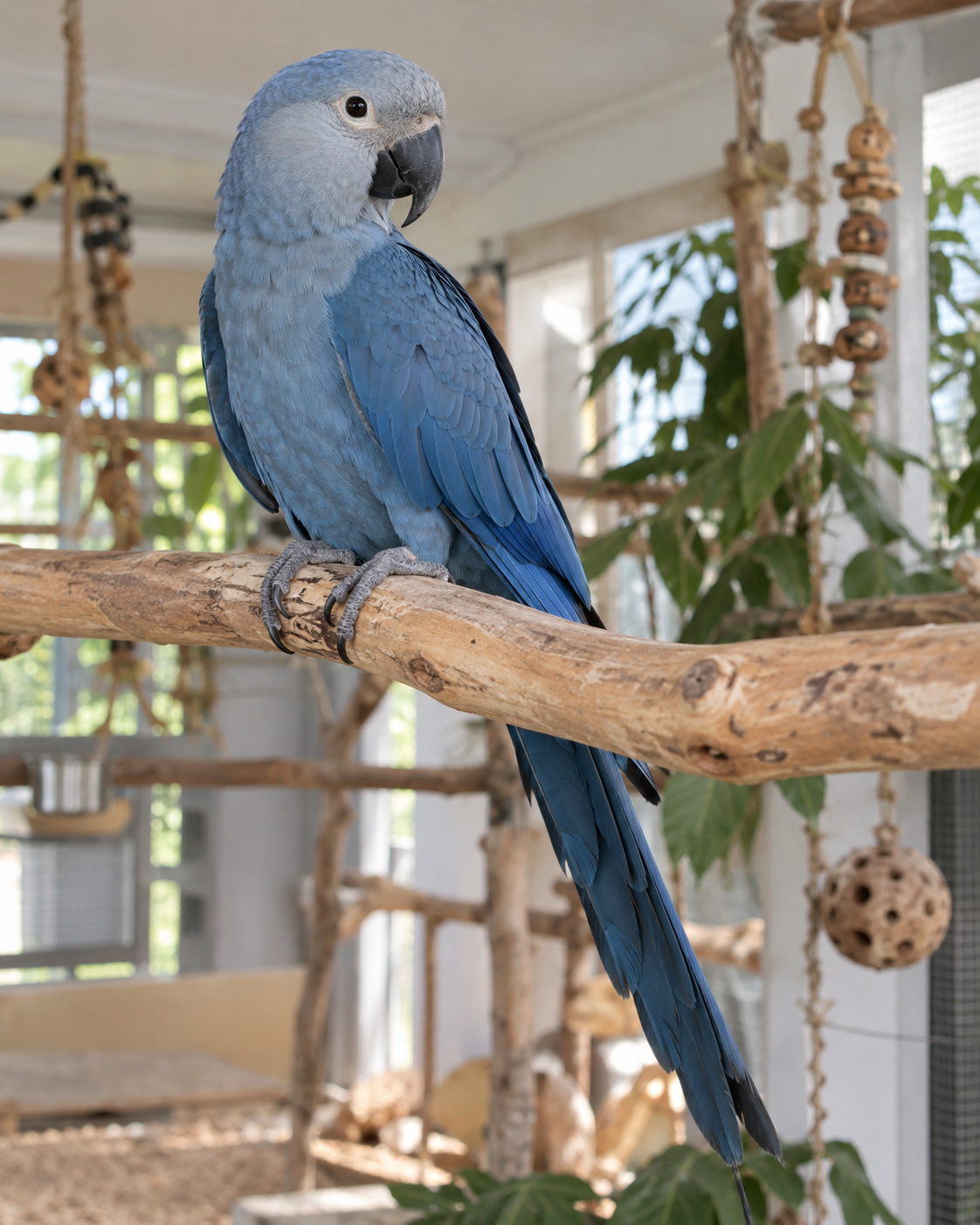
The Spix’s Macaw, scientifically known as Cyanopsitta spixii, is a rare blue macaw native to Brazil. Also called the Little Blue Macaw, adults have soft blue plumage with darker blue wings and back, a greyish-blue head and a black bill. Adults reach approximately 21.8 inches and weigh around 360 grams. The reported Spix’s Macaw lifespan is approximately 30–40 years. The species remains classified as Extinct in the Wild despite conservation releases beginning in Brazil.
Spix’s Macaw – Cyanopsitta spixii
The Spix’s Macaw is one of the world’s rarest and most recognizable macaws.
Scientifically classified as Cyanopsitta spixii, this distinctive blue parrot is also commonly called the Little Blue Macaw.
The species once occurred naturally in the Rio São Francisco Valley of northern Bahia, Brazil, but habitat destruction and illegal trapping caused a catastrophic decline.
The last known wild Spix’s Macaw disappeared in 2000. Since then, conservation breeding programs have worked to rebuild the population, with captive-bred birds released into Brazil beginning in 2022 and further releases occurring in 2025.
The World Parrot Trust currently reports more than 360 Spix’s Macaws in captivity.
Spix’s Macaw Details
- Common Name: Spix’s Macaw
- Alternative Name: Little Blue Macaw
- Scientific Name: Cyanopsitta spixii
- Bird Type: Macaw
- Adult Size: Approximately 21.8 inches
- Adult Weight: Approximately 360 g
- Reported Lifespan: Approximately 30–40 years
- Primary Colour: Blue
- Conservation Status: Extinct in the Wild
- CITES Listing: Appendix I
- Historic Range: Northern Bahia, Brazil
What Does a Spix’s Macaw Look Like?
The Spix’s Macaw has a much softer blue appearance than the intense cobalt colouring of a Hyacinth Macaw.
Adult birds have predominantly soft blue plumage.
The back and wings are darker blue, while the head has a noticeably greyish-blue tone.
Adults have a grey eye ring, yellow eyes and a black bill.
Young Spix’s Macaws resemble adults but generally have a white eye ring, darker brown eyes and a bill showing both black and horn-coloured areas.
This combination of relatively compact size and soft blue plumage makes Cyanopsitta spixii visually distinct from larger blue macaw species.
Spix’s Macaw Size
The adult Spix’s Macaw size is approximately 56 cm, or 21.8 inches.
Adults weigh around 360 grams, or 12.6 ounces.
This makes the Spix’s Macaw substantially smaller than the Hyacinth Macaw.
Although compact compared with giant macaw species, it still has the characteristic long tail, strong curved bill and body proportions associated with macaws.
Spix’s Macaw Lifespan
The reported Spix’s Macaw lifespan is approximately 30–40 years.
Actual longevity can vary according to genetics, diet, veterinary care, environment and overall husbandry.
For birds maintained in professional conservation programs, long-term health management is especially important because every individual can contribute to the genetic and demographic future of the species.
Spix’s Macaw Sounds
Spix’s Macaws are vocal birds, although their natural call differs from that of some larger macaws.
The World Parrot Trust describes the call as resonant, quieter and more wavering than that of a Hyacinth Macaw, with some screeching notes also produced.
Vocal communication forms part of normal macaw behaviour and may vary by individual and situation.
Natural Habitat of the Spix’s Macaw
Historically, the Spix’s Macaw occurred in the Rio São Francisco Valley in northern Bahia, Brazil.
The species depended heavily on gallery woodland associated with seasonal waterways.
Of particular importance were caraiba trees, which provided nesting cavities in the caatinga ecosystem.
The destruction of this highly specialized habitat was one of the major factors behind the species’ disappearance from the wild.
What Did Wild Spix’s Macaws Eat?
The natural diet included seeds and fruits from plants found within their specialized habitat.
Recorded food sources included seeds from Cnidoscolus phyllacanthus and Jatropha pohlianna, along with fruits and seeds from other native plants.
Captive conservation programs use carefully managed diets designed around individual health and breeding requirements.
Housing and Enrichment
The World Parrot Trust lists a walk-in enclosure with a minimum length of approximately 7 metres, or 23 feet, for captive Spix’s Macaws.
These birds are also described as vigorous chewers.
Suitable enrichment can include:
- Bird-safe branches
- Natural limbs
- Planted aviary areas
- Climbing opportunities
- Foraging activities
- Safe chewable materials
The goal is to provide opportunities for natural movement and behavioural activity rather than simple confinement.
Diet Under Professional Care
World Parrot Trust husbandry information references foods such as sprouted or soaked seeds, walnuts, pecans, Brazil nuts, pine nuts, fresh corn, vegetables, fruit and complete macaw food. Palm fruits may also be used where appropriate.
However, individual feeding programs should be established according to veterinary and conservation-management guidance.
The Association of Avian Veterinarians provides professional bird-care information:
Association of Avian Veterinarians
Why Did the Spix’s Macaw Disappear From the Wild?
Two major pressures drove the species toward extinction:
Habitat destruction and illegal trapping for the wild-bird trade.
The species had a highly restricted range and depended on specific woodland habitat for nesting.
As these environments disappeared and birds were removed from the wild, the remaining population became increasingly vulnerable.
By the late twentieth century, only a tiny number of wild individuals remained.
The Last Known Wild Spix’s Macaw
A major search supported by the World Parrot Trust in 1990 located one remaining wild Spix’s Macaw.
That individual survived for several more years but disappeared by 2000, leading to the species being treated as extinct in the wild.
Captive breeding programs then became the primary hope for restoring the species.
Spix’s Macaw Reintroduction
The story has changed significantly in recent years.
Conservation-bred Spix’s Macaws were released into their historical range in Brazil beginning in 2022, with additional releases occurring in 2025.
The Association of Avian Veterinarians reported that 11 released individuals were living freely in the wild following these programs.
These birds represent a major step toward restoring a free-living population.
However, the species remains formally categorized as Extinct in the Wild while reintroduction efforts continue.
Conservation Challenges
Reintroduction is considerably more complicated than simply releasing captive birds.
Conservation teams must consider:
- Habitat availability
- Genetics
- Disease screening
- Breeding success
- Predator exposure
- Food availability
- Population monitoring
Disease management has become particularly important.
The Association of Avian Veterinarians reported that Psittacine Beak and Feather Disease (PBFD) was detected in a bird from the Spix’s Macaw breeding population in July 2025, leading to a planned release being suspended while specialists investigated disease prevalence.
This illustrates how carefully reintroduction programs must be managed.
Spix’s Macaw Conservation Status
The Spix’s Macaw remains classified as Extinct in the Wild and is listed under CITES Appendix I.
More than 360 individuals are reported in captivity, creating the breeding population from which reintroduction efforts are being developed.
Because the species is so rare and conservation-dependent, its management differs substantially from that of commonly kept companion macaws.
Spix’s Macaw vs Hyacinth Macaw
The Spix’s Macaw and Hyacinth Macaw are both blue, but they are very different birds.
Spix’s Macaw
- Approximately 21.8 inches
- About 360 g
- Soft blue plumage
- Greyish head
- Cyanopsitta spixii
Hyacinth Macaw
- Much larger
- Deep cobalt-blue plumage
- Bright yellow skin around the eyes and lower bill
- Anodorhynchus hyacinthinus
The Spix’s Macaw is therefore substantially smaller and lighter in colour.
Why the Spix’s Macaw Is Exceptional
Few parrots have a conservation history comparable to the Spix’s Macaw.
The species disappeared from the wild after the loss of its specialized habitat and decades of trapping.
Today, more than 360 captive birds form the foundation of an international recovery effort, while conservation-bred individuals have begun returning to Brazil.
Its future depends on conservation breeding, habitat restoration, veterinary science and carefully managed reintroduction.
For anyone researching Cyanopsitta spixii, understanding this conservation story is essential to understanding the species itself.
Frequently Asked Questions
What is the scientific name of Spix’s Macaw?
The scientific name is Cyanopsitta spixii.
Is Spix’s Macaw also called the Little Blue Macaw?
Yes. Little Blue Macaw is another common name for the species.
How large is a Spix’s Macaw?
Adults measure approximately 56 cm, or 21.8 inches.
How much does a Spix’s Macaw weigh?
Adults weigh approximately 360 grams, or 12.6 ounces.
What is the Spix’s Macaw lifespan?
The reported lifespan is approximately 30–40 years.
What colour is a Spix’s Macaw?
Adults have soft blue plumage with darker blue wings and back and a greyish-blue head.
Is the Spix’s Macaw extinct?
The species is officially classified as Extinct in the Wild, although captive-bred birds were released in Brazil in 2022 and 2025 as part of an ongoing reintroduction program.
How many Spix’s Macaws exist?
The World Parrot Trust currently reports more than 360 individuals in captivity, alongside conservation-bred birds released into the wild.
Where did Spix’s Macaws originally live?
The historic range was the Rio São Francisco Valley of northern Bahia, Brazil.
Where can I learn more about professional avian care?
The Association of Avian Veterinarians provides professional bird-care resources:
Be the first to review “Spix’s Macaw”
Related products

Macaw Parrots
Macaw Parrots


Macaw Parrots

Macaw Parrots

Macaw Parrots


Macaw Parrots


Macaw Parrots


Macaw Parrots
Reviews
There are no reviews yet.