



Eastern Rosella for Sale
$850.00
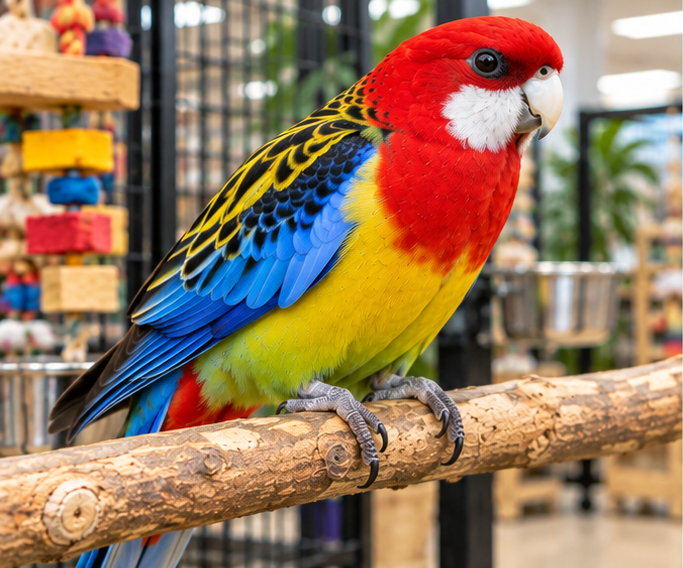
Male and female Eastern Rosellas are represented in this listing. Scientifically known as Platycercus eximius, this colourful Australian parakeet is recognized for its red head and upper breast, white cheek patches, yellow lower breast, blue wings and patterned black-and-green back. Adults reach approximately 11.7 inches and weigh around 95–120 grams. The reported Eastern Rosella lifespan is around 20 years, making suitable flight space, enrichment, balanced nutrition and avian veterinary care important parts of long-term ownership.
Eastern Rosella for Sale – Male & Female
For buyers researching an Eastern Rosella for sale, the Eastern Rosella is one of the most colourful Australian parakeets commonly kept in aviculture.
Scientifically classified as Platycercus eximius, the species is also known as the Common Rosella, White-cheeked Rosella, Red-headed Rosella and Golden-mantled Rosella.
Adult Eastern Rosellas reach approximately 30 cm, or 11.7 inches, and weigh around 95–120 grams.
The combination of a bright red head, white cheeks, yellow breast, blue wings and heavily patterned back makes this species immediately recognizable.
Eastern Rosella Details
- Common Name: Eastern Rosella
- Scientific Name: Platycercus eximius
- Bird Type: Australian Parakeet
- Sex Represented: Male and Female
- Adult Size: Approximately 11.7 inches
- Adult Weight: Approximately 95–120 g
- Reported Lifespan: Around 20 years
- Primary Colours: Red, yellow, blue, black, green and white
- CITES Listing: Appendix II
- IUCN Status: Least Concern
Three recognized subspecies are generally listed: P. e. eximius, P. e. elecica and P. e. diemenensis.
What Does an Eastern Rosella Look Like?
The Eastern Rosella parrot has one of the most varied colour combinations among Australian parakeets.
Adult males of the nominate form have a bright red head and upper breast, large white cheek patches and a yellow lower breast.
The abdomen becomes pale green, while the undertail coverts are red.
The back is predominantly black with green spotting or edging, creating the scalloped appearance typical of rosellas.
The outer wing coverts are blue, and the rump is pale green.
The bill is pale or white, while the eyes are brown.
Male and Female Eastern Rosellas
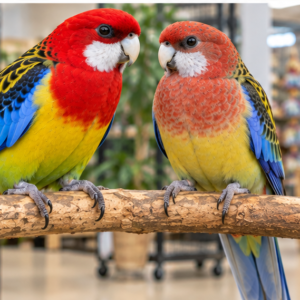
Male and female Eastern Rosellas have broadly similar colour patterns, but the female is usually somewhat duller.
The World Parrot Trust notes that females generally have a paler head and breast than males and may show a pale stripe beneath the wing.
These differences can be subtle.
If a buyer specifically wants a male or female bird, appropriate breeder records or professional sex testing provide greater certainty than visual estimation alone.
Eastern Rosella Size
The typical Eastern Rosella reaches approximately 11.7 inches in overall length.
Adults weigh around 95–120 grams.
Although significantly smaller than macaws and many Amazon parrots, Eastern Rosellas are active birds that benefit from generous horizontal flight space.
A compact body should therefore not be interpreted as meaning the bird can live comfortably in a very small enclosure.
Eastern Rosella Lifespan
The World Parrot Trust reports an Eastern Rosella longevity of approximately 20 years under captive conditions.
Actual lifespan can vary depending on:
- Genetics
- Nutrition
- Exercise
- Housing
- Veterinary care
- Environmental safety
- Overall husbandry
Prospective owners should therefore prepare for a long-term commitment.
Eastern Rosella Price
People researching Eastern Rosella price should avoid relying on a single generic market figure.
The price of an individual bird can vary according to:
- Age
- Sex
- Subspecies
- Colour
- Handling history
- Health information
- Documentation
- Location
- Availability
Because no exact selling price has been provided for this listing, the current product price should be displayed directly rather than inserting an unsupported estimate.
Long-term costs should also be considered, including appropriate housing, food, enrichment and veterinary care.
Eastern Rosella Behaviour
Wild Eastern Rosellas can be found in pairs or groups and often feed on the ground or in low vegetation.
Their natural habitats frequently overlap with farmland, parks, gardens and suburban areas, which helps explain why the species can adapt to a range of environments.
In captivity, individual personality varies.
Birds benefit from:
- Predictable routines
- Flight opportunities
- Foraging
- Chewing
- Bathing
- Environmental enrichment
Regular interaction should respect the individual bird’s temperament rather than forcing handling.
Eastern Rosella Sounds
Eastern Rosellas have several distinct vocalizations.
The World Parrot Trust describes the flight call as sharp, while perched birds may produce a three-syllable whistle on an ascending scale.
They can also produce metallic notes, piping sounds, soft chatter while feeding and shrill calls when startled.
This makes them vocal without having the same powerful volume associated with large macaws.
Housing an Eastern Rosella
Suitable housing should prioritize flight space.
The World Parrot Trust recommends a walk-in enclosure with a minimum length of approximately 3 metres, or 9.8 feet.
A suitable environment should include:
- Clear horizontal flight space
- Natural perches
- Multiple perch positions
- Feeding stations
- Bathing opportunities
- Bird-safe branches
- Chewing materials
- Foraging activities
Overcrowding the enclosure with accessories can reduce usable flight space, so enrichment should be balanced with movement.
Enrichment and Activity
Eastern Rosellas benefit from fresh, untreated branches and safe chewable materials.
The World Parrot Trust recommends fresh branches, heat-sterilized pine cones, wooden toys, vegetable-tanned leather toys and bathing bowls.
Additional enrichment can include:
- Foraging activities
- Natural perches
- Swings
- Safe shreddable materials
- Flight opportunities
The Association of Avian Veterinarians identifies sensory, nutritional, manipulative, environmental and behavioural enrichment as useful categories for companion birds.
Eastern Rosella Diet
A varied feeding plan is important.
The World Parrot Trust lists small-seed mixtures, sprouted foods, cooked legumes, leafy greens, vegetables, fruits, nuts and complete formulated foods among captive feeding options.
Nutrition should still be adapted to the individual bird’s age, health and activity level.
The Association of Avian Veterinarians provides bird-owner resources covering basic care, foraging and diet-related topics:
Association of Avian Veterinarians – Bird Owner Resources
Natural Range of the Eastern Rosella
The Eastern Rosella is native to southeastern Australia and Tasmania.
Different subspecies occur across parts of:
- South Australia
- New South Wales
- Victoria
- Queensland
- Tasmania
Habitats include open forests, woodland, riverine forests, eucalyptus stands, grasslands, farmland and suburban environments.
The species can occur at elevations up to approximately 1,250 metres, or 4,100 feet.
Eastern Rosella Conservation Status
The Eastern Rosella is currently classified as Least Concern and listed under CITES Appendix II.
The World Parrot Trust reports the overall population trend as increasing, although the Tasmanian subspecies P. e. diemenensis is declining.
Responsible sourcing remains important even when a species is not globally threatened.
Eastern Rosella Parakeet vs Crimson Rosella
The Eastern Rosella parakeet and Crimson Rosella belong to the same genus, Platycercus, but their colour patterns are very different.
Eastern Rosella
- Red head
- White cheeks
- Yellow lower breast
- Green abdomen
- Black-and-green patterned back
- Blue wing feathers
Crimson Rosella
- Predominantly crimson-red body
- Blue-purple cheek patches
- Blue wing and tail markings
This difference makes the Eastern Rosella easy to distinguish once the main colour pattern is understood.
Veterinary Care
An avian veterinarian should be identified before acquiring a companion parrot.
The Association of Avian Veterinarians recommends regular checkups for companion birds and provides resources covering basic bird care, diet, enrichment and signs of illness.
Routine examinations can help monitor:
- Weight
- Body condition
- Plumage
- Beak
- Feet
- Diet
- General health
Association of Avian Veterinarians
Preparing for Eastern Rosella Ownership
Before choosing an Eastern Rosella for sale, the bird’s environment should already be prepared.
A suitable setup should include:
- Adequate flight space
- Safe natural perches
- Food and water stations
- Bathing access
- Bird-safe enrichment
- A balanced feeding plan
- Access to avian veterinary care
The bird’s potential 20-year lifespan should also be considered when planning for long-term ownership.
Why the Eastern Rosella Is Distinctive
The Eastern Rosella combines several bold colours within a relatively compact Australian parakeet.
Its red head, white cheeks, yellow breast, green abdomen, black-patterned back and blue wings create an appearance that is difficult to confuse with most other companion parrots.
For buyers searching for an Eastern Rosella for sale, accurate identification, individual sex, housing, veterinary planning and responsible sourcing should all be considered alongside purchase price.
Frequently Asked Questions
What is the scientific name of the Eastern Rosella?
The scientific name is Platycercus eximius.
Is the Eastern Rosella a parrot or parakeet?
It is an Australian parakeet within the parrot family. Both Eastern Rosella parrot and Eastern Rosella parakeet are commonly used search descriptions.
How big is an Eastern Rosella?
Adults reach approximately 30 cm, or 11.7 inches.
How much does an Eastern Rosella weigh?
Adults generally weigh around 95–120 grams.
How long does an Eastern Rosella live?
The World Parrot Trust reports approximately 20 years in captivity.
What is the Eastern Rosella price?
The Eastern Rosella price varies according to age, sex, subspecies, condition, documentation, location and availability. The actual current selling price should be displayed on the individual listing.
What colours does an Eastern Rosella have?
Typical adults combine a red head and upper breast, white cheeks, yellow lower breast, green abdomen, black-and-green back and blue wing feathers.
Can you tell male and female Eastern Rosellas apart?
Females are generally somewhat duller than males and may show a pale stripe beneath the wing, although professional confirmation is preferable when sex certainty matters.
Are Eastern Rosellas common in captivity?
Yes. The World Parrot Trust describes the species as quite common in captivity.
Where can I learn more about professional bird care?
The Association of Avian Veterinarians provides companion-bird care resources:
Be the first to review “Eastern Rosella for Sale”
Related products


Australian Parakeets
Australian Parakeets

Australian Parakeets


Australian Parakeets
Reviews
There are no reviews yet.