


Scarlet-Chested Parrot

$650.00
Male and female Scarlet-Chested Parrots are represented in this listing. Scientifically known as Neophema splendida, this small Australian parakeet is recognised for bright green upper plumage, vivid blue facial colouring and, in adult males, a striking scarlet chest bordered by yellow-orange underparts. Adults reach approximately 7.8 inches and weigh around 36–44 grams. Their compact size does not reduce their need for suitable flight space, enrichment, balanced nutrition and regular avian veterinary care.
Scarlet-Chested Parrot – Male & Female
The Scarlet-Chested Parrot is a small Australian parakeet with one of the most distinctive colour combinations within the Neophema group.
Scientifically classified as Neophema splendida, it is also commonly known as the Scarlet-breasted Parrot, Scarlet-chested Grass-Parakeet and Splendid Parrot.
Adult birds measure approximately 20 cm, or 7.8 inches, and weigh around 36–44 grams.
The adult male is particularly striking, combining a blue face, bright green upperparts and a vivid scarlet breast. Females have a much softer colour pattern, which makes this one of the Australian parakeets where adult males and females can often be distinguished visually.
Scarlet-Chested Parrot Details
- Common Name: Scarlet-Chested Parrot
- Alternative Names: Splendid Parrot, Scarlet-breasted Parrot
- Scientific Name: Neophema splendida
- Bird Type: Australian Parakeet
- Sex Represented: Male and Female
- Adult Size: Approximately 7.8 inches
- Adult Weight: Approximately 36–44 g
- Reported Lifespan: Around 10 years
- Natural Range: Australia
- Conservation Status: Least Concern
- CITES Listing: Appendix II
The wild population is currently considered stable, although numbers can fluctuate considerably depending on environmental conditions.
What Does a Male Scarlet-Chested Parrot Look Like?
The adult male Scarlet-Chested Parrot is exceptionally colourful.
The upperparts are bright green, while the face is an intense blue.
The front of the neck and central breast are vivid scarlet-red. Below the red chest, the lower underparts transition into orange and yellow.
The upper wing coverts are also blue, creating strong contrast with the green back.
The central tail feathers are green, while the bill is black and the eyes are brown-grey.
This combination of green, blue, scarlet and yellow-orange makes the male easy to identify once mature.
What Does a Female Scarlet-Chested Parrot Look Like?
Female Scarlet-Chested Parrots have a more subdued colour pattern.
The blue facial colouring is paler than in adult males, while the breast remains predominantly green rather than developing the male’s bright scarlet patch.
Females also have pale blue upper wing coverts and may show a pale underwing stripe.
This sexual dimorphism makes adult sex identification easier than in species where males and females look nearly identical.
Scarlet-Chested Parrot Size
The typical adult Scarlet-Chested Parrot measures approximately 7.8 inches in length.
Adults weigh only around 36–44 grams.
Despite this small size, the species should not be kept in cramped housing.
These birds naturally move through open, dry Australian environments and benefit from enough horizontal space to fly between perches.
Scarlet-Chested Parrot Lifespan
The World Parrot Trust reports captive longevity of approximately 10 years.
Individual lifespan can vary depending on:
- Genetics
- Nutrition
- Exercise
- Housing
- Veterinary care
- Environmental safety
- Overall husbandry
A lifespan figure should therefore be treated as a general expectation rather than a guarantee for an individual bird.
Scarlet-Chested Parrot Temperament
Scarlet-Chested Parrots are generally active, lightweight parakeets that benefit from a calm, well-structured environment.
They are naturally ground-feeding birds and often spend time exploring lower parts of an enclosure.
A suitable daily environment can encourage:
- Flying
- Foraging
- Bathing
- Scratching through appropriate substrate
- Exploring branches
- Social interaction
Individual birds vary in confidence and tolerance of handling, so temperament should always be evaluated bird by bird.
Scarlet-Chested Parrot Sounds
This species is generally less overpowering vocally than large parrots.
The World Parrot Trust describes flight calls as soft, two-syllable notes that can sound like chirps when repeated.
Flocks produce continuous soft twittering, while alarm calls can become sharper and more whistle-like.
This does not mean the species is silent, but its natural vocal profile is significantly different from the loud calls of macaws or Amazon parrots.
Housing a Scarlet-Chested Parrot
Flight space is important.
The World Parrot Trust recommends a walk-in enclosure with a minimum length of approximately 2.1 metres, or 7 feet, or an indoor aviary approximately 1.8 metres, or 6 feet, long.
A well-designed environment should provide:
- Horizontal flight space
- Natural perches
- Multiple perch heights
- Safe feeding stations
- Bathing access
- Ground-level foraging opportunities
- Bird-safe branches
These birds naturally feed on the ground, so the lower part of the enclosure should be considered part of their usable habitat.
Enrichment and Natural Behaviour
The World Parrot Trust recommends bathing bowls, bird-safe branches, foraging toys and, where practical, safe soil or substrate that allows the birds to scratch and explore.
Useful enrichment can include:
- Natural branches
- Seeding grasses
- Foraging activities
- Bathing dishes
- Safe ground exploration
- Small bird-safe toys
Because the species is a relatively light chewer, enrichment should focus as much on flight and foraging as on destructive chewing.
Scarlet-Chested Parrot Diet
Wild Scarlet-Chested Parrots feed primarily on grass and plant seeds.
Recorded natural foods include seeds from Triodia, Acacia and other arid-zone plants.
Under captive care, the World Parrot Trust references small seed mixtures, spray millet, leafy greens, seeding grasses, suitable fruits and complete formulated foods as possible components of a managed diet.
Individual nutrition should still be adapted according to age, health and veterinary guidance.
For professional bird-care information:
Association of Avian Veterinarians
Natural Range of the Scarlet-Chested Parrot
The Scarlet-Chested Parrot is native to the interior regions of Australia.
Its range extends across inland areas from the southwest toward southeastern Australia, with a substantial association with the Great Victoria Desert.
Typical habitats include:
- Arid mallee scrub
- Mulga scrubland
- Spinifex country
- Open eucalyptus woodland
- Casuarina woodland
- Saltbush plains
The species may respond rapidly when environmental conditions improve, with local population increases occurring after favourable rainfall or habitat changes.
Scarlet-Chested Parrot Conservation Status
The species is currently classified as Least Concern and listed under CITES Appendix II.
The World Parrot Trust reports that its wild population is stable overall, although local declines have been recorded in Western Australia and New South Wales.
Habitat clearance and altered fire patterns may reduce suitable habitat in some areas.
Responsible captive sourcing remains important even where a species is not considered globally threatened.
Scarlet-Chested Parrot Breeding Facts
Scarlet-Chested Parrots typically nest in tree hollows.
The reported breeding season generally runs from August to January, and a typical clutch contains around four to six eggs. Young birds generally fledge at around four to five weeks.
One particularly interesting behaviour is that the female may carry green leaves into the nest tucked among her rump feathers.
Scarlet-Chested Parrot vs Bourke’s Parrot
Both species are relatively small Australian parakeets, but they are visually very different.
Scarlet-Chested Parrot
- Bright green upper body
- Blue face
- Scarlet chest in males
- Yellow-orange lower underparts
- Approximately 7.8 inches
Bourke’s Parrot
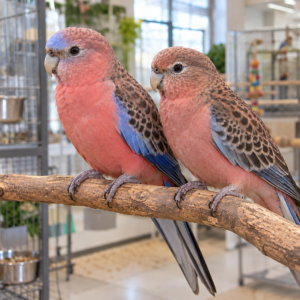
- Dusty pink breast
- Brown-grey upper plumage
- Soft blue markings
- Approximately 7.5 inches
The Scarlet-Chested Parrot has a much brighter colour pattern, particularly in adult males.
Scarlet-Chested Parrot vs Turquoise Parrot
Both belong to the genus Neophema and can display strong blue and green colour.
The male Scarlet-Chested Parrot is distinguished by the large scarlet chest patch, whereas the Turquoise Parrot has a different arrangement of red, blue, yellow and green markings.
Scientific names help keep them distinct:
- Scarlet-Chested Parrot: Neophema splendida
- Turquoise Parrot: Neophema pulchella
Veterinary Care
An avian veterinarian should be identified before acquiring any parrot.
Regular examinations can help establish baseline information regarding:
- Body weight
- Plumage
- Beak
- Feet
- Nutrition
- Activity
- General health
The Association of Avian Veterinarians maintains a professional veterinarian directory for bird owners.
Association of Avian Veterinarians
Preparing for Scarlet-Chested Parrot Ownership
Before bringing home a Scarlet-Chested Parrot, the enclosure should already be prepared.
A suitable setup should provide:
- Horizontal flight space
- Natural perches
- Bathing access
- Ground-foraging opportunities
- Safe enrichment
- Appropriate nutrition
- Access to avian veterinary care
The bird’s small body size should never be used as a reason to restrict its opportunity for normal movement.
Why the Scarlet-Chested Parrot Is Distinctive
The Scarlet-Chested Parrot combines a remarkably small body with dramatic colour.
Adult males display bright green upperparts, a blue face, vivid scarlet chest and yellow-orange lower underparts, while females have a more subdued green and blue appearance.
At approximately 7.8 inches and only 36–44 grams, Neophema splendida is a lightweight Australian parakeet that still benefits from substantial flight space and behavioural enrichment.
For anyone considering this species, accurate sex identification, suitable housing, legitimate captive sourcing and ongoing veterinary care should all be part of responsible ownership.
Frequently Asked Questions
What is the scientific name of the Scarlet-Chested Parrot?
The scientific name is Neophema splendida.
Is the Scarlet-Chested Parrot also called the Splendid Parrot?
Yes. Splendid Parrot and Scarlet-breasted Parrot are commonly used alternative names.
How big is a Scarlet-Chested Parrot?
Adults reach approximately 20 cm, or 7.8 inches.
How much does a Scarlet-Chested Parrot weigh?
Adults weigh approximately 36–44 grams.
How long does a Scarlet-Chested Parrot live?
The World Parrot Trust reports a captive lifespan of approximately 10 years.
What colour is a male Scarlet-Chested Parrot?
Adult males have green upperparts, a bright blue face, a scarlet chest and yellow-orange lower underparts.
What colour is a female Scarlet-Chested Parrot?
Females generally have paler blue facial markings and a green breast rather than the bright scarlet chest seen in males.
Are Scarlet-Chested Parrots loud?
Their normal calls are generally softer than those of large parrots, including chirps, twittering and sharper alarm whistles.
What is the conservation status of the Scarlet-Chested Parrot?
The species is classified as Least Concern, with a stable global population trend, and is listed under CITES Appendix II.
Where can I learn more about avian care?
The Association of Avian Veterinarians provides professional bird-care information:
Be the first to review “Scarlet-Chested Parrot”
Related products

Australian Parakeets
Australian Parakeets
Australian Parakeets


Australian Parakeets
Reviews
There are no reviews yet.