


Solomon Island Eclectus for Sale
Original price was: $1,200.00.$999.00Current price is: $999.00.
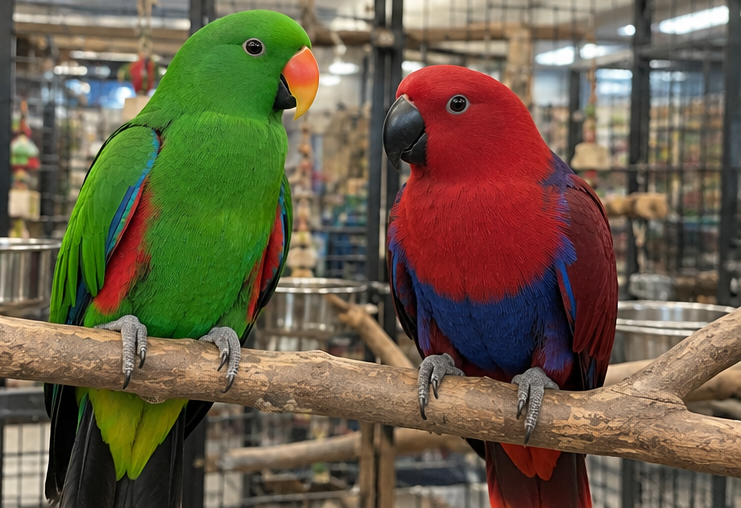
Male and female Solomon Island Eclectus parrots are represented in this listing. Scientifically classified as Eclectus polychloros solomonensis, this striking Eclectus form is native to the Solomon Islands and nearby island groups. Mature males are predominantly brilliant green with orange-yellow upper beaks, blue flight feathers and red colouring beneath the wings, while females display vivid red plumage with deep blue across portions of the breast and abdomen. Adults are approximately 13.6 inches long, and the broader Papuan Eclectus group generally weighs around 450–600 grams. These intelligent parrots require appropriate housing, balanced nutrition, enrichment and long-term avian veterinary care.
Solomon Island Eclectus for Sale – Male & Female
For buyers researching a Solomon Island Eclectus for sale, this colourful parrot is one of the most visually distinctive members of the Eclectus group.
The Solomon Island Eclectus is scientifically classified as Eclectus polychloros solomonensis and belongs to the Papuan Eclectus species, Eclectus polychloros.
One of the most remarkable characteristics of the Solomon Island Eclectus parrot is the dramatic difference between adult males and females.
Males are predominantly brilliant green, while females are mainly intense red combined with deep blue colouring.
This extreme sexual dimorphism makes mature birds relatively easy to distinguish by sex compared with many other parrot species.
Solomon Island Eclectus Details
- Common Name: Solomon Island Eclectus
- Scientific Name: Eclectus polychloros solomonensis
- Species: Papuan Eclectus
- Bird Type: Eclectus Parrot
- Sex Represented: Male and Female
- Adult Size: Approximately 13.6 inches
- Typical Weight Range: Approximately 450–600 g for Papuan Eclectus
- Potential Lifespan: Up to approximately 50 years
- Male Colours: Green, blue and red
- Female Colours: Red and deep blue
- Natural Region: Solomon Islands and nearby island groups
- Conservation Status: Least Concern
- CITES Listing: Appendix II
What Does a Male Solomon Island Eclectus Look Like?
The adult male Solomon Island Eclectus is predominantly bright green.
The head and neck usually appear somewhat darker green than the central body.
Blue can be seen through portions of the flight feathers, while vivid red appears under the wings and along the sides of the body.
The male’s beak is one of the easiest identifying features.
The upper mandible is orange and becomes more yellow toward the tip, while the lower mandible is black.
The tail is mainly green with lighter yellowish or whitish colouring toward the ends.
This combination of emerald-green plumage, blue wing accents and an orange-yellow beak creates the characteristic appearance of a mature male Eclectus.
What Does a Female Solomon Island Eclectus Look Like?
The adult female looks dramatically different.
Female Solomon Island Eclectus parrots are predominantly bright red across the head, neck and upper breast.
Deep blue colouring appears across the lower breast, abdomen and portions of the underwing area.
Depending on the individual, blue may also appear around parts of the back or shoulder region.
The female’s beak is completely black.
Her tail is predominantly red and may show orange colouring near the tips.
The contrast between the red upper body and rich blue lower body makes the female particularly distinctive.
Male vs Female Solomon Island Eclectus
Mature males and females are easy to distinguish visually.
Male Solomon Island Eclectus:
- Brilliant green body
- Orange-yellow upper beak
- Black lower mandible
- Blue wing feathers
- Red underwing colouring
Female Solomon Island Eclectus:
- Vivid red head and body
- Deep blue lower breast and abdomen
- Black beak
- Red tail
- Strong red-and-blue contrast
These differences make the Eclectus one of the most sexually dimorphic parrots commonly kept in aviculture.
Solomon Island Eclectus Size
The Papuan Eclectus group reaches approximately 13.6 inches in length.
Typical adult weight is around 450–600 grams, although individual size can vary according to sex, age and condition.
Despite being shorter than many macaws, Eclectus parrots have a broad and substantial body.
Housing therefore needs to provide enough space for:
- Full wing stretching
- Climbing
- Comfortable turning
- Flight or active movement
- Multiple perch locations
- Foraging
- Bathing
Solomon Island Eclectus Lifespan
The Solomon Island Eclectus can be a very long-term companion.
Eclectus parrots may live up to approximately 50 years under suitable captive conditions.
Actual lifespan depends on factors including:
- Genetics
- Diet
- Body condition
- Veterinary care
- Exercise
- Housing
- Environmental safety
- Long-term husbandry
Prospective owners should therefore prepare for decades of care.
Solomon Island Eclectus Personality
Eclectus parrots are intelligent and socially complex birds.
Individual personality varies, but they often benefit from a predictable environment and regular opportunities to interact with their surroundings.
A suitable routine may include:
- Foraging
- Training
- Climbing
- Exploring
- Bathing
- Social interaction
- Safe chewing activities
Handling should respect the individual bird’s temperament rather than being forced.
Are Solomon Island Eclectus Parrots Vocal?
Yes.
The Solomon Island Eclectus parrot is naturally vocal.
Calls may include:
- Loud flight calls
- Rough screeches
- Alarm calls
- Mellow social sounds
- Bell-like vocalizations
Some Eclectus calls can carry over considerable distances.
Prospective owners should therefore expect normal parrot noise and consider whether their household can accommodate it.
Housing a Solomon Island Eclectus
Adequate movement space is important.
Professional avicultural guidance for the Papuan Eclectus recommends an aviary or suspended enclosure with a minimum length of approximately 9.8 feet.
A suitable environment should provide:
- Natural wooden perches
- Multiple perch diameters
- Climbing opportunities
- Feeding and water stations
- Foraging toys
- Safe chewable materials
- Bathing access
- Open space for movement
The enclosure should not be so crowded with accessories that the bird cannot move comfortably.
Solomon Island Eclectus Diet
Nutrition is especially important for Eclectus parrots.
A varied captive diet may include appropriate formulated parrot food together with suitable fruits, vegetables, legumes and fresh greens.
Suitable fresh foods may include:
- Apple
- Pear
- Pomegranate
- Banana
- Orange
- Carrot
- Celery
- Green peas
- Beans
- Fresh corn
- Leafy greens
Cooked or sprouted legumes may also form part of a managed diet.
Fruit can provide useful variety, but feeding should remain nutritionally balanced rather than becoming dominated by sweet foods.
Individual dietary needs should be discussed with an avian veterinarian.
Enrichment for Solomon Island Eclectus Parrots
Eclectus parrots benefit from regular mental stimulation.
Suitable enrichment can include:
- Puzzle toys
- Foraging toys
- Natural branches
- Bird-safe chewing materials
- Swings
- Ropes
- Bathing
- Interactive games
Food-based enrichment can also encourage natural searching and problem-solving behaviours.
Rotating suitable toys can prevent the environment from becoming repetitive.
Natural Range of the Solomon Island Eclectus
The Solomon Island Eclectus occurs across island regions of the southwest Pacific.
Its range includes:
- Admiralty Islands
- Bismarck Archipelago
- Buka
- Bougainville
- Solomon Islands
The range extends south to Makira Island, although the subspecies is absent from several surrounding islands.
These parrots inhabit wooded environments, particularly lowland forest.
Natural Habitat
The broader Papuan Eclectus occurs in many wooded habitats.
These can include:
- Primary lowland forest
- Mangroves
- Freshwater swamp forest
- Coastal scrub
- Savanna woodland
- Plantations
- Secondary forest
- Garden areas
They are often most common below approximately 1,000 metres elevation.
What Do Wild Solomon Island Eclectus Parrots Eat?
Wild Eclectus parrots consume a range of plant foods.
Their natural diet may include:
- Fruits
- Seeds
- Nuts
- Leaf buds
- Nectar
- Blossoms
They may also visit farmland to feed on fruit and corn.
This natural feeding diversity helps explain why varied enrichment and appropriate fresh foods are important under captive care.
Natural Behaviour
Wild Eclectus parrots can occur:
- Alone
- In pairs
- In small groups
They may fly high over forested areas while calling loudly.
Birds are particularly active during the early morning and later afternoon as they travel between feeding and roosting areas.
Large communal roosts can contain many birds.
Solomon Island Eclectus Breeding
Eclectus parrots nest in tree cavities.
The broader Papuan Eclectus breeding period commonly occurs from approximately April through September.
A typical clutch contains around two eggs.
Young birds generally fledge at around 11 weeks.
Captive breeding requires appropriate experience with:
- Pair compatibility
- Nesting behaviour
- Nutrition
- Genetics
- Veterinary screening
- Chick development
Breeding should not be attempted simply because a male and female bird are housed together.
Solomon Island Eclectus Conservation
The Papuan Eclectus is currently classified as Least Concern and listed under CITES Appendix II.
The estimated mature population is approximately 990,000–1,100,000 birds, although the overall trend is decreasing.
Major threats include:
- Deforestation
- Habitat clearance
- Hunting
- Trapping for wildlife trade
Large-scale lowland forest clearance throughout parts of the Solomon Islands has affected available habitat.
Responsible sourcing is therefore important.
Solomon Island Eclectus vs Red Sided Eclectus
The terminology can be confusing because both names are associated with the Papuan Eclectus group.
The Solomon Island Eclectus refers specifically to Eclectus polychloros solomonensis.
“Red-sided Eclectus” is another common name used within the wider Eclectus polychloros group.
For accurate product SEO, the exact bird should therefore be identified using the Solomon Island Eclectus name when the bird is specifically E. p. solomonensis.
Solomon Island Eclectus vs Moluccan Eclectus
The Solomon Island Eclectus and Moluccan Eclectus are related but belong to different currently recognized groups.
Solomon Island Eclectus
- Eclectus polychloros solomonensis
- Part of the Papuan Eclectus
- Native to Solomon Islands and nearby regions
Moluccan Eclectus
- Eclectus roratus
- Native primarily to the Moluccan region
Colour differences, geographic origin and taxonomy should be considered when identifying birds accurately.
Veterinary Care
An avian veterinarian should be identified before bringing home a Solomon Island Eclectus.
Routine examinations can help monitor:
- Weight
- Body condition
- Beak
- Feet
- Plumage
- Nutrition
- Respiratory health
- General wellbeing
Because Eclectus parrots can live for decades, preventive veterinary care is particularly important.
For professional companion-bird information:
Association of Avian Veterinarians
Preparing for Solomon Island Eclectus Ownership
Before choosing a Solomon Island Eclectus for sale, the bird’s environment should already be prepared.
A suitable setup should provide:
- Spacious housing
- Natural perches
- Climbing opportunities
- Safe enrichment
- Foraging activities
- Bathing access
- Balanced nutrition
- Regular veterinary care
Owners should also consider vocalization, daily interaction requirements and the financial responsibility associated with decades of care.
Why the Solomon Island Eclectus Is Distinctive
The Solomon Island Eclectus combines an unusual social biology with some of the strongest sexual colour differences found among parrots.
The adult male’s brilliant green plumage and orange-yellow beak contrast dramatically with the female’s bright red and deep blue colouring.
For buyers researching a Solomon Island Eclectus for sale, appearance should be only part of the decision.
Individual health, sex, captive origin, socialization, diet, housing and long-term veterinary planning should all be considered before ownership.
Frequently Asked Questions
What is the scientific name of the Solomon Island Eclectus?
The scientific name is Eclectus polychloros solomonensis.
Is the Solomon Island Eclectus a separate species?
It is currently treated as a subspecies of the Papuan Eclectus, Eclectus polychloros.
How big is a Solomon Island Eclectus?
The Papuan Eclectus group reaches approximately 13.6 inches in length.
How much does a Solomon Island Eclectus weigh?
Adults in the wider Papuan Eclectus group generally weigh approximately 450–600 grams.
How long does a Solomon Island Eclectus live?
Eclectus parrots may live up to approximately 50 years under suitable captive care.
What colour is a male Solomon Island Eclectus?
Adult males are predominantly bright green with blue wing feathers, red underwing colouring and an orange-yellow upper beak.
What colour is a female Solomon Island Eclectus?
Adult females are predominantly bright red with deep blue across the lower breast and abdomen and an entirely black beak.
Can you tell male and female Solomon Island Eclectus parrots apart?
Yes. Mature males and females have dramatically different plumage.
What does a Solomon Island Eclectus eat?
A balanced captive diet can include appropriate formulated foods, vegetables, leafy greens, legumes and suitable fruit based on individual veterinary guidance.
Are Solomon Island Eclectus parrots vocal?
Yes. They can produce loud flight calls, rough screeches and softer social vocalizations.
Where does the Solomon Island Eclectus come from?
Its natural range includes the Solomon Islands, Bismarck Archipelago, Admiralty Islands, Buka and Bougainville.
Where can I learn more about professional Eclectus care?
The Association of Avian Veterinarians provides professional companion-bird care information:
Be the first to review “Solomon Island Eclectus for Sale”
Related products
Eclectus Parrots
Reviews
There are no reviews yet.